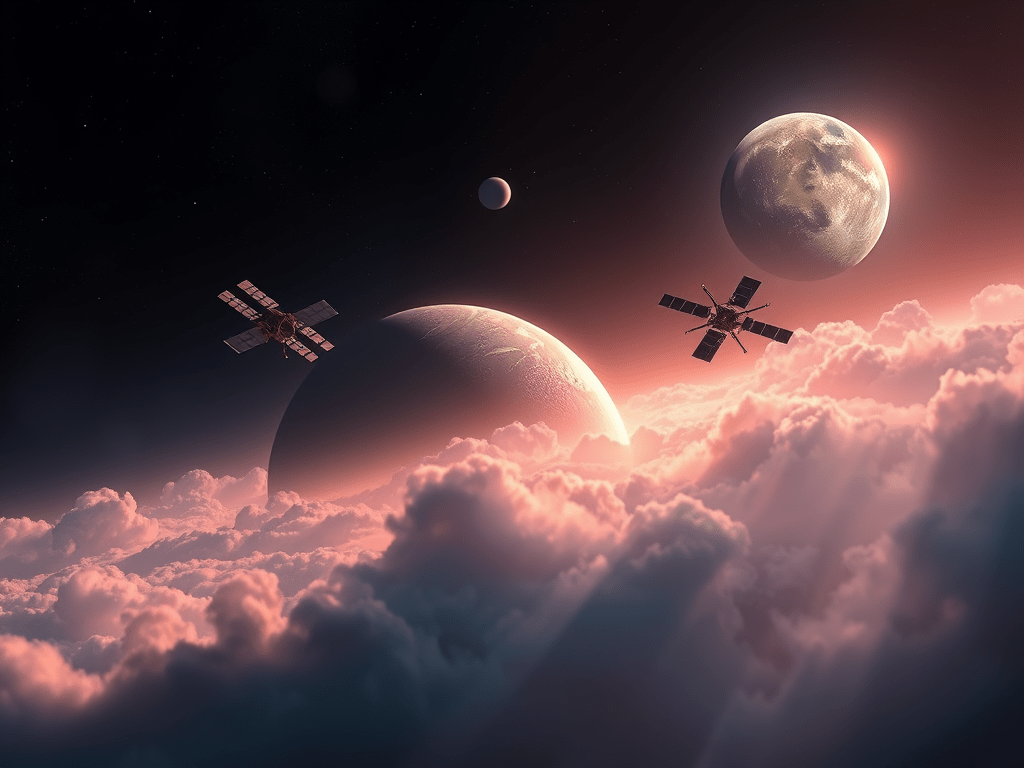
Exploring Venus: NASA’s VERITAS and ESA’s EnVision Missions
Venus, often overshadowed by the allure of Mars, is set to take center stage with two groundbreaking missions: NASA’s VERITAS and the European Space Agency’s (ESA) EnVision. These missions aim to unravel the mysteries of Earth’s enigmatic twin and shed light on its turbulent history. Here’s a closer look at these ambitious endeavors.
NASA’s VERITAS: Mapping Venus in High Definition
VERITAS (Venus Emissivity, Radio Science, InSAR, Topography, and Spectroscopy) is NASA’s answer to the many questions surrounding Venus. Scheduled for launch later this decade, VERITAS aims to provide an unprecedented view of Venus’ surface and geology.
Mission Goals:
- High-Resolution Mapping: Using synthetic aperture radar, VERITAS will create detailed 3D maps of Venus’ surface, helping scientists identify geological features and tectonic activity.
- Surface Composition Analysis: The spacecraft’s spectrometer will study the chemical composition of rocks, offering clues about the planet’s volcanic history.
- Understanding Tectonics: VERITAS will investigate whether Venus is still geologically active, a question that could provide insights into its dramatic transformation.
ESA’s EnVision: Peering Beneath the Clouds
ESA’s EnVision mission complements VERITAS by focusing on Venus’ subsurface and atmosphere. Slated to launch in the 2030s, EnVision will use advanced radar and spectrometry tools to build a comprehensive picture of the planet’s inner workings.
Mission Goals:
- Radar Sounding: EnVision’s radar will probe beneath Venus’ thick clouds to study its crust and search for evidence of past or present tectonic activity.
- Atmospheric Studies: By examining Venus’ atmosphere, EnVision will explore its complex chemistry and the factors contributing to its runaway greenhouse effect.
- Comparative Planetology: EnVision aims to answer why Venus and Earth, so similar in size and composition, evolved so differently.
Why Study Venus?
Venus is a cautionary tale for planetary climate and geological change. Once thought to harbor oceans, Venus experienced a runaway greenhouse effect, turning it into an uninhabitable furnace. By studying Venus, scientists hope to:
- Gain insights into climate processes on Earth and other planets.
- Understand the conditions that lead to planetary habitability.
- Explore the potential for past microbial life on Venus.
The Future of Venus Exploration
The combined efforts of VERITAS and EnVision signal a renewed interest in Venus. These missions will pave the way for future explorations, potentially including atmospheric probes or even surface landers to further uncover Venus’ secrets.
A New Era of Discovery
With VERITAS and EnVision on the horizon, we are entering a new era of Venus exploration. These missions promise to answer long-standing questions and inspire a deeper appreciation for our dynamic and complex solar system. Venus may have been overlooked in the past, but it’s finally getting the attention it deserves as one of the most intriguing planets in our cosmic neighborhood.
 Cosmic Watchers