Voyager 1 and Voyager 2: Humanity’s Pioneers to the Stars
In the vastness of space, two small spacecraft, Voyager 1 and Voyager 2, continue their journey beyond our solar system. Launched in 1977 by NASA, these twin probes were designed to explore the outer planets, but they have far exceeded their original missions, becoming humanity’s emissaries to the stars.
The Mission Begins
Voyager 1 and Voyager 2 were launched within weeks of each other in the summer of 1977. Their primary mission was to take advantage of a rare planetary alignment that occurs only once every 176 years. This alignment allowed the spacecraft to use gravitational assists to visit Jupiter, Saturn, Uranus, and Neptune in a single journey.
- Voyager 1: Launched on September 5, 1977, it focused on Jupiter and Saturn, providing detailed images and groundbreaking data about these gas giants and their moons.
- Voyager 2: Launched earlier, on August 20, 1977, it remains the only spacecraft to have visited Uranus and Neptune, offering humanity its first close-up views of these icy giants.
Key Discoveries
Both spacecraft made significant contributions to our understanding of the solar system:
- Jupiter: Discovered active volcanoes on Io and complex weather systems on Jupiter itself.
- Saturn: Revealed the intricacies of Saturn’s rings and studied its largest moon, Titan.
- Uranus: Voyager 2 captured images of Uranus’ faint rings and its 27 moons, as well as discovering its unusual magnetic field.
- Neptune: Observed Neptune’s Great Dark Spot and its supersonic winds, along with the icy surface of its moon, Triton.
The Golden Records
Both spacecraft carry a Golden Record, a 12-inch gold-plated copper disc containing sounds and images representing the diversity of life and culture on Earth. Curated by a team led by Carl Sagan, the record includes:
- Greetings in 55 languages
- Sounds of nature, like ocean waves and birdsong
- Music from various cultures, including Bach, Beethoven, and Chuck Berry’s “Johnny B. Goode”
- Images of Earth and its inhabitants
The Golden Record serves as a time capsule and a message to any extraterrestrial life that might find it.
Leaving the Solar System
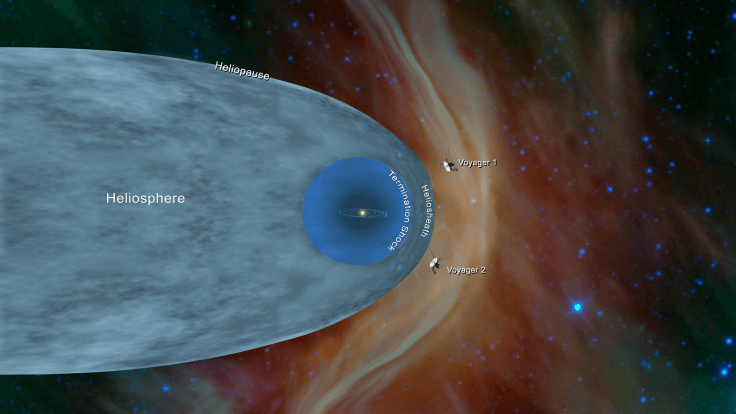
- Voyager 1: In 2012, Voyager 1 became the first human-made object to enter interstellar space, crossing the heliopause—the boundary where the Sun’s influence ends.
- Voyager 2: Followed suit in 2018, entering interstellar space and continuing to send back data about this uncharted region.
Challenges and Longevity
The Voyagers were built to last five years, yet they have been operational for over 46 years. Their continued function is a testament to the ingenuity of their design and the skill of the engineers who built and maintained them. However, their power sources—radioisotope thermoelectric generators (RTGs)—are gradually depleting, and the spacecraft will eventually go silent.
A Legacy Beyond Measure
Voyager 1 and Voyager 2 are not just scientific instruments; they are symbols of humanity’s curiosity and desire to explore. They remind us of our place in the cosmos and our ability to reach for the stars. Even after they stop transmitting, they will continue their journey, silently drifting through the galaxy as testaments to human ingenuity and ambition.
As of now, Voyager 1 and Voyager 2 are the farthest human-made objects from Earth, carrying with them the hopes and dreams of our species into the unknown.
Acknowledgment: This article features images courtesy of NASA.
 Cosmic Watchers
Leave a comment