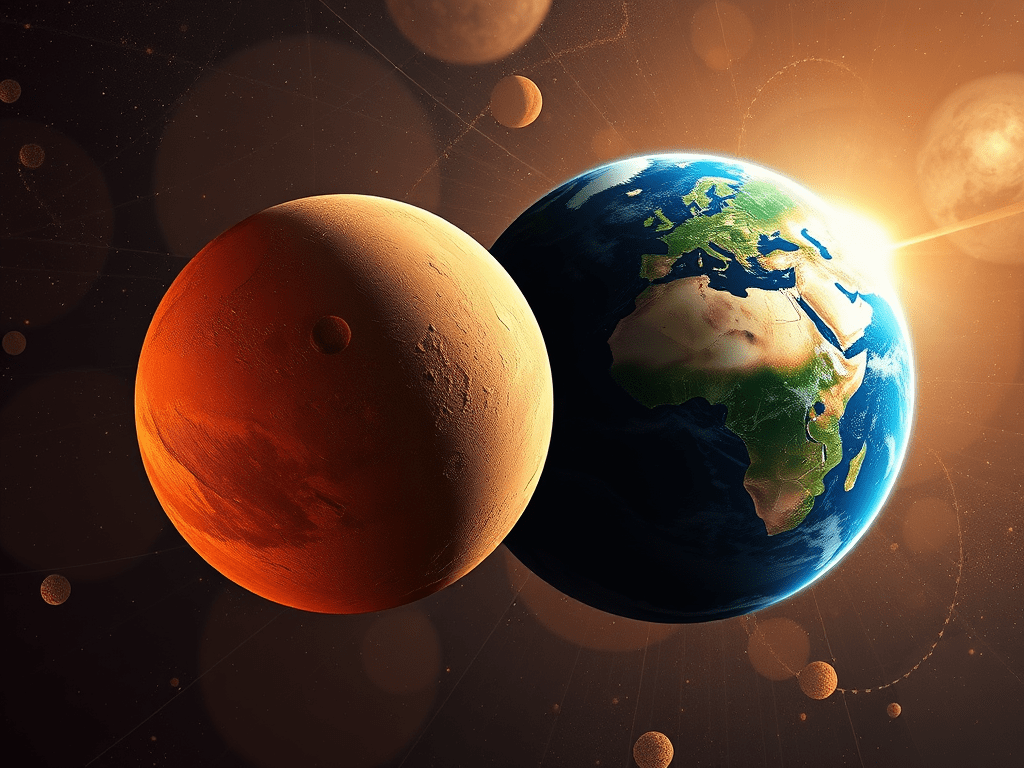
What Came First: Mars or Earth?
When it comes to our solar system, the timeline of planetary formation is a cosmic puzzle. Among the planets, Earth and Mars often invite comparisons due to their similarities and differences. But which of these two rocky neighbors came first in the grand scheme of things? Let’s dive into the fascinating story of planetary origins to uncover the answer.
The Birth of the Solar System
About 4.6 billion years ago, a giant cloud of gas and dust called the solar nebula began to collapse under its own gravity. This process gave birth to our Sun, and the remaining material flattened into a swirling disk, where the planets started to form.
In this chaotic early solar system, tiny grains of dust collided and stuck together, growing into larger and larger chunks. Over time, these chunks became planetesimals—the building blocks of planets. Through continued collisions and gravitational attraction, these planetesimals coalesced into the planets we know today.
Mars vs. Earth: Who Came First?
Both Mars and Earth formed during this turbulent time, but evidence suggests that Mars may have taken shape slightly earlier than Earth. Scientists believe this because:
- Size Matters: Mars is smaller than Earth, with less gravitational pull. This likely allowed it to cool and solidify more quickly than our larger, more complex planet.
- Old Rocks: Martian meteorites, which have fallen to Earth, show signs of being extremely ancient—some over 4.4 billion years old—hinting that Mars’ crust formed earlier.
- Simpler Composition: Mars lacks the tectonic activity that reshaped Earth’s surface over billions of years, preserving its early history more clearly.
Earth: The Late Bloomer
Earth, on the other hand, took a bit longer to settle down. Its larger size and proximity to the Sun meant it underwent more intense bombardment from asteroids and comets in its early days. This period, known as the Late Heavy Bombardment, likely delayed the formation of Earth’s stable crust. Additionally, the collision that formed our Moon about 4.5 billion years ago would have reset Earth’s surface, making it harder to pinpoint its earliest moments.
Why Does It Matter?
Understanding the timeline of Mars and Earth’s formation isn’t just about satisfying curiosity. It helps scientists unravel the conditions that made Earth habitable and Mars potentially capable of supporting life. By studying Mars’ ancient surface, we get a glimpse of what Earth might have looked like in its infancy.
 Cosmic Watchers
Leave a comment