Introduction
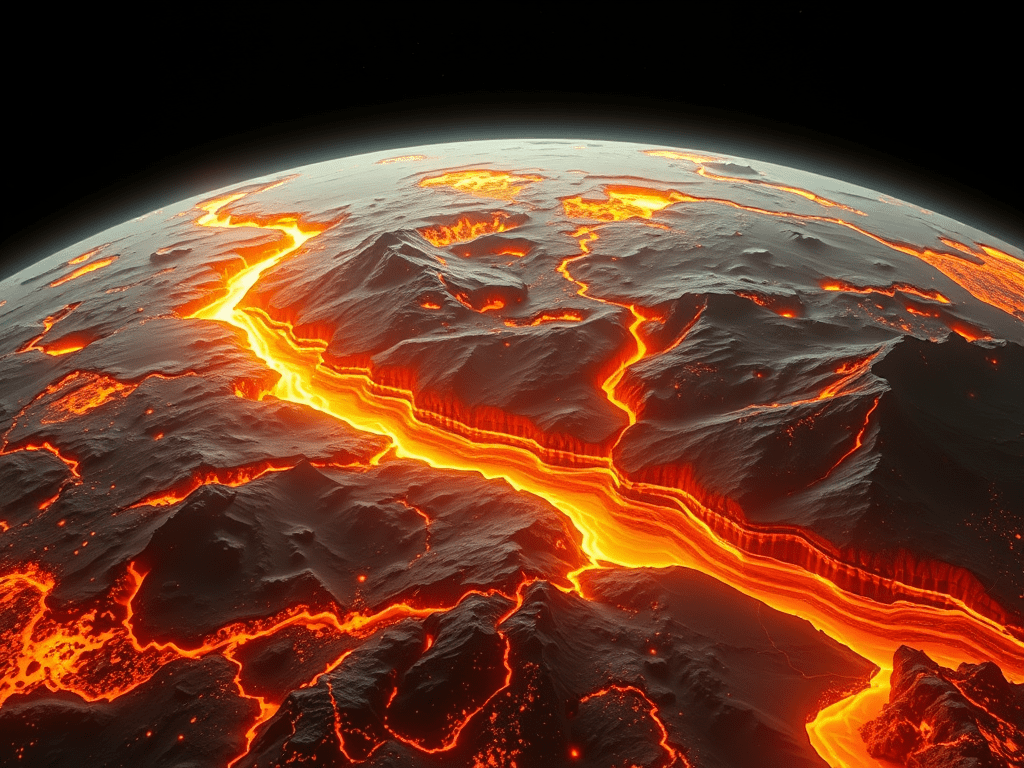
Imagine a world where the ground is constantly reshaped by explosive volcanic eruptions, where rivers of molten lava carve fiery pathways across an alien landscape. Welcome to Io, Jupiter’s hellish moon and the most volcanically active body in the solar system. Discovered by Galileo Galilei in 1610, this celestial powerhouse is a chaotic realm of roaring geysers, towering mountains, and eerie sulfuric plains—an astronomical wonder that continues to captivate scientists and space enthusiasts alike.
A Land of Fire and Fury
- Volcanic Inferno
Io’s surface is a hellscape of constantly erupting volcanoes, spewing plumes of lava hundreds of miles into space. These volcanic behemoths are powered by Jupiter’s immense gravitational pull, which stretches and squeezes Io’s interior, creating extreme heat. If Earth’s most violent volcanoes seem powerful, they pale in comparison to Io’s continuous eruptions, which paint its surface in glowing rivers of fire. - A Toxic, Otherworldly Beauty
Io’s surface glows in surreal hues of yellow, orange, and red, thanks to layers of sulfur deposited by its volcanic activity. The moon is practically a living canvas of geological chaos, with no impact craters in sight—each new eruption erases any evidence of past collisions. This ever-changing landscape makes Io one of the most visually striking bodies in the solar system. - Mountains That Defy Imagination
Io is not just a world of lava—it’s also home to mountains that dwarf even Everest. These peaks, formed by relentless geological upheaval, rise to astonishing heights, creating some of the most dramatic and alien terrain in the solar system. Unlike Earth’s plate tectonics, Io’s mountains are formed by intense internal pressures that continuously reshape the landscape.
A Moon Under Constant Attack
- A Ghostly Atmosphere
Io has a fragile, whisper-thin atmosphere primarily composed of sulfur dioxide. It is so tenuous that it would barely register as air, and yet it plays a crucial role in Io’s dynamic environment. With each eruption, the atmosphere is replenished, a continuous cycle of destruction and renewal. - Jupiter’s Electrified Playground
As if being covered in volcanoes wasn’t extreme enough, Io is also bombarded by Jupiter’s relentless magnetic field. This interaction generates powerful electrical currents between the moon and its giant host, lighting up Jupiter’s auroras in a cosmic dance of energy. If you ever visited Io (and somehow survived), you’d be at the heart of one of the most extreme electromagnetic environments in the solar system.
Io Through the Eyes of Science
Io has been a prime target for space missions eager to unravel its secrets:
- Voyager 1 and 2 (1979): Delivered the first jaw-dropping images of Io’s active volcanoes, stunning the scientific community.
- Galileo (1990s-2000s): Conducted long-term observations, revealing the moon’s dynamic surface and magnetic interactions.
- Juno (2016-present): Continues to investigate Io’s role in Jupiter’s complex system, providing unprecedented insights into its volatile nature.
Conclusion
Io is a moon like no other—a celestial inferno shaped by forces so powerful they continuously remake its surface. Studying Io offers an unparalleled glimpse into planetary geology, extreme environments, and the raw power of gravitational interactions. With future missions on the horizon, who knows what other secrets this volcanic world will reveal? One thing is certain—Io will keep erupting, dazzling, and reshaping itself, proving that in the grand stage of the cosmos, it is one of the most dramatic performers.
 Cosmic Watchers
Leave a comment