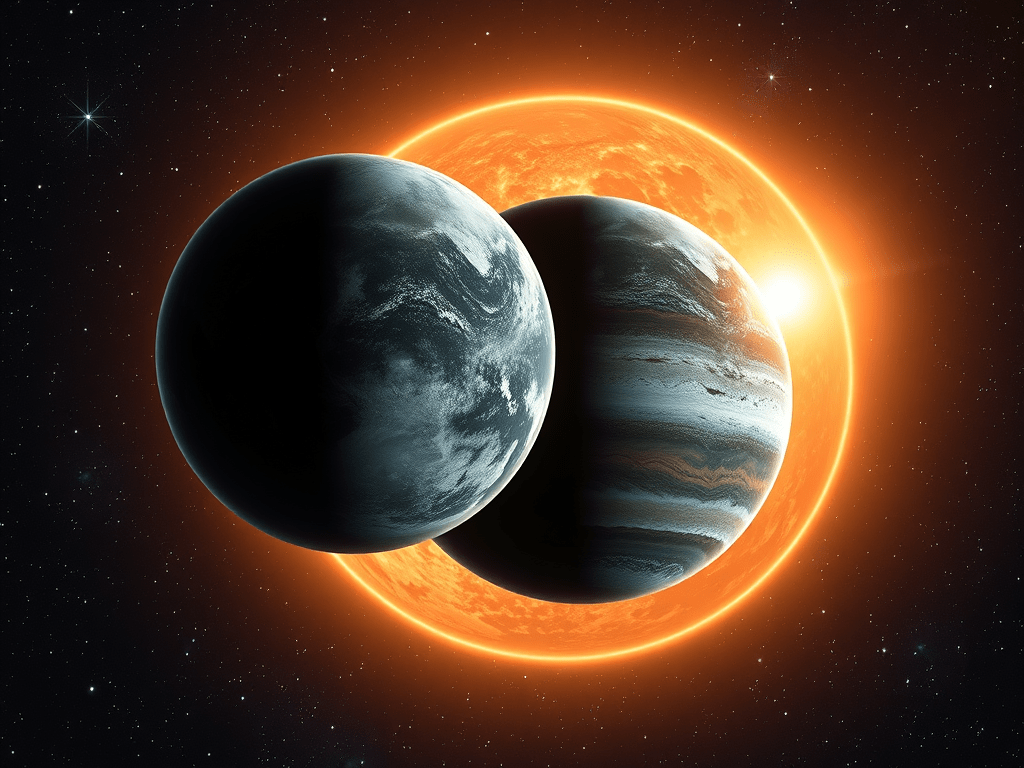
HD 101581 is a K-type main-sequence star located approximately 41.7 light-years away in the constellation Centaurus. With an apparent magnitude of 7.77, it is not visible to the naked eye but can be observed with small telescopes. This relatively close star has attracted scientific interest due to the discovery of two Earth-sized exoplanets, HD 101581 b and HD 101581 c, orbiting in close proximity.
The Host Star: HD 101581
- Type: K-type main-sequence star
- Mass: ~0.74 times the mass of the Sun
- Radius: ~0.63 times the Sun’s radius
- Temperature: ~4,634 K
HD 101581 is cooler and smaller than our Sun, making it an interesting target for exoplanet studies. The lower temperature means that planets in its habitable zone would have to be much closer than Earth is to the Sun.
The Exoplanets: HD 101581 b & HD 101581 c
In 2024, astronomers using NASA’s Transiting Exoplanet Survey Satellite (TESS) discovered two Earth-sized exoplanets orbiting HD 101581. These planets were detected using the transit method, which observes dips in a star’s brightness when a planet passes in front of it.
HD 101581 b
- Radius: ~0.956 times Earth’s radius
- Mass: Estimated upper limit of 3.6 Earth masses
- Orbital Period: 4.47 days
- Semi-Major Axis: ~0.046 AU (very close to the star)
- Equilibrium Temperature: ~834 K (561°C or 1,042°F)
HD 101581 c
- Radius: ~0.99 times Earth’s radius
- Mass: Estimated upper limit of 4.2 Earth masses
- Orbital Period: 6.21 days
- Semi-Major Axis: ~0.057 AU
- Equilibrium Temperature: ~747 K (474°C or 885°F)
Extreme Conditions and Potential for Study
Both HD 101581 b and c orbit very close to their host star, resulting in high surface temperatures that likely make them inhospitable to life as we know it. Due to their proximity, these planets are likely tidally locked, meaning one side perpetually faces the star while the other remains in darkness.
What makes these planets particularly intriguing is that HD 101581 is the brightest known star with multiple transiting Earth-sized exoplanets. This brightness makes it an excellent candidate for future atmospheric studies using instruments like the James Webb Space Telescope (JWST). By analyzing their atmospheres, scientists can gain insights into their compositions, weather patterns, and potential for unique geological or atmospheric processes.
Conclusion
HD 101581 itself is a star, but it hosts two fascinating Earth-sized exoplanets that provide new opportunities for exoplanetary research. As more data is collected, astronomers hope to better understand these distant worlds and their interactions with their host star. This system is another exciting step in the search for planets beyond our solar system and the ongoing exploration of the cosmos.
 Cosmic Watchers