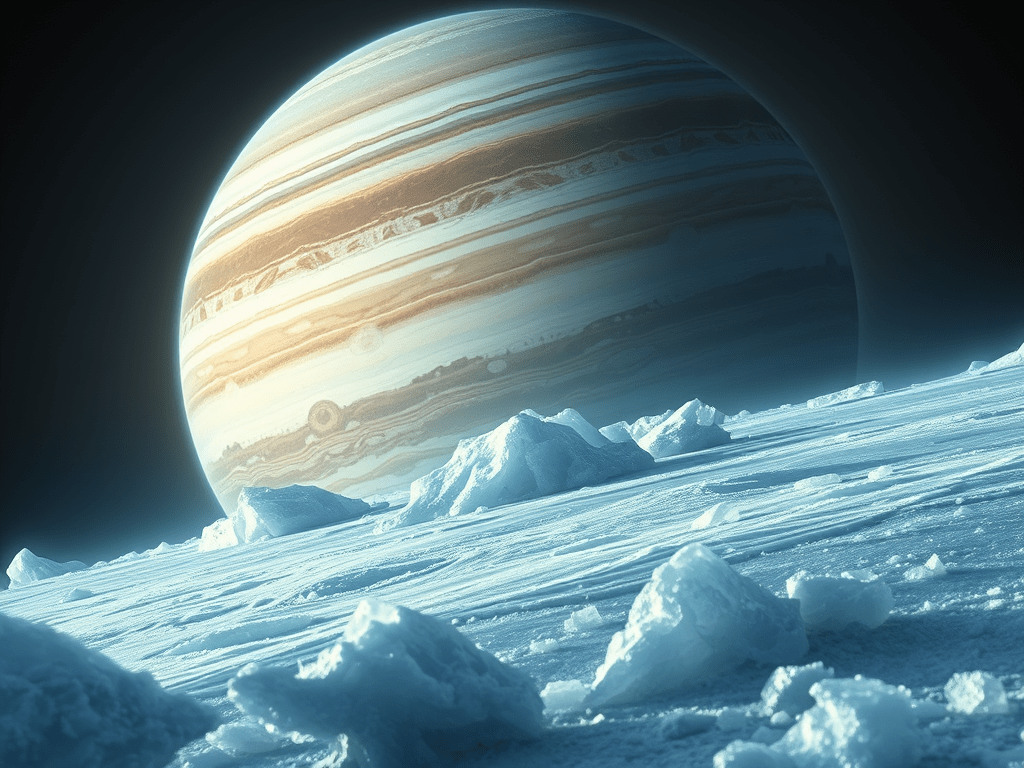
As we look beyond Mars, we enter a region of the solar system dominated by giant planets—Jupiter, Saturn, Uranus, and Neptune. These massive worlds are nothing like Earth; they are made mostly of gas, with no solid surface to stand on. But if we’re searching for extraterrestrial life, we shouldn’t just focus on planets—we should look at their moons.
One of the most intriguing is Europa, a moon of Jupiter that appears similar to our own Moon in size and shape. However, there’s one key difference: Europa is covered in ice. At first, this might seem like an instant disqualifier for life. After all, how could anything survive in such a frozen wasteland? But if we take a closer look, we realize that ice doesn’t mean lifelessness.
What Lies Beneath Europa’s Ice?
We don’t have to travel far to see proof that life can survive in icy conditions—just look at Earth’s Arctic and Antarctic regions. These places are covered in thick ice, yet beneath the frozen surface, the ocean teems with life. Fish, plankton, and even large mammals thrive in the frigid waters.
Scientists believe that a similar ocean exists beneath Europa’s icy shell, but it’s much deeper than any ocean on Earth. The moon’s thick ice acts as a protective barrier, shielding the water below from deadly radiation and cosmic hazards. And just like Earth’s deep-sea hydrothermal vents—where heat and minerals escape from the seafloor—Europa may have similar sources of energy, warming its ocean and creating the perfect conditions for life.
Why Haven’t We Found Life Yet?
The biggest challenge in confirming life on Europa is the thickness of its ice. We know there’s an ocean underneath, but we haven’t been able to reach it yet. NASA’s upcoming Europa Clipper mission will study the moon in greater detail, searching for signs of life or at least the ingredients necessary for it.
Europa isn’t the only candidate for extraterrestrial life. Saturn’s moon Enceladus is another frozen world with a hidden ocean, and we’ve already detected water plumes erupting from its surface, hinting at the possibility of an underground ecosystem.
Are We on the Verge of a Breakthrough?
If life exists anywhere else in the solar system, Europa and Enceladus are among the best places to look. These moons challenge our understanding of where life can exist, proving that even in the coldest, most extreme environments, life finds a way.
For now, we wait for future missions to provide answers. But one thing is clear: the discovery of alien life—whether microscopic organisms or something more complex—would change everything we know about the universe.
Stay tuned to Cosmic Watchers as we continue exploring the mysteries of space. Could Europa’s ocean hold the first proof of life beyond Earth? We may not have to wait much longer to find out.
 Cosmic Watchers
Leave a comment