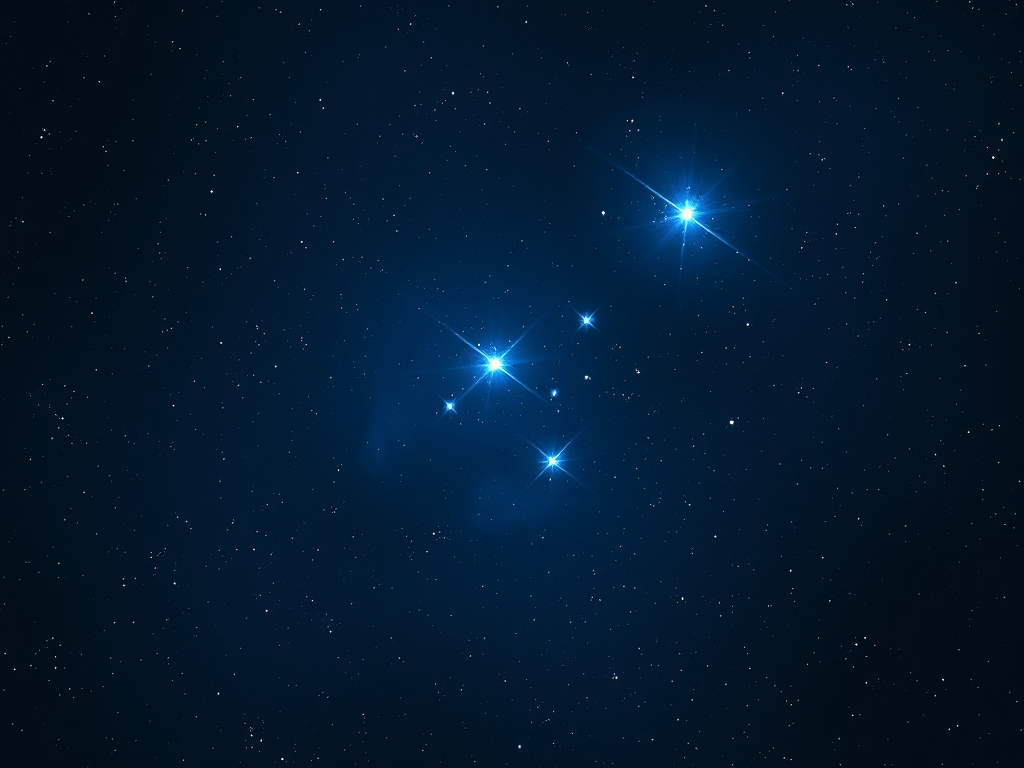
The Pleiades, also known as the Seven Sisters, is one of the most stunning and easily recognizable star clusters in the night sky. Located in the constellation Taurus, the Pleiades has fascinated astronomers, storytellers, and skywatchers for thousands of years. This open star cluster holds significance in various cultures and continues to be a subject of scientific exploration.
Astronomical Overview
The Pleiades is an open star cluster approximately 444 light-years from Earth. It consists of over 1,000 stars, though only a handful are visible to the naked eye under good viewing conditions. The most prominent stars in the cluster include Alcyone, Atlas, Electra, Maia, Merope, Taygeta, and Pleione. These hot, blue stars are relatively young, estimated to be around 100 million years old.
Surrounding the brightest stars is a faint reflection nebula, which was once believed to be the remnants of the dust cloud from which the cluster formed. However, modern studies suggest that the Pleiades is simply passing through a region of interstellar dust that reflects the blue light of its young stars.
Some rookie stargazers mistake the Pleiades for the Little Dipper, as its compact and bright stars resemble a tiny dipper-shaped pattern in the sky.
Cultural and Mythological Significance
The Pleiades has been mentioned in the mythology and folklore of many civilizations, including Greek, Native American, Japanese, and Aboriginal Australian cultures.
- Greek Mythology: The cluster is named after the seven daughters of the Titan Atlas and the sea nymph Pleione. According to legend, the sisters were pursued by Orion, the great hunter, and were eventually transformed into stars by Zeus to escape his advances.
- Native American Traditions: Various tribes, including the Lakota and the Cherokee, have legends tied to the Pleiades, often associating the cluster with themes of creation, guidance, and ancestral spirits.
- Japanese Culture: In Japan, the Pleiades is known as Subaru, meaning “unite.” The famous automobile brand Subaru features a stylized depiction of the cluster in its logo.
Scientific Importance
The Pleiades is an essential object of study for astronomers. Since its stars are relatively close and young, studying them provides valuable insights into stellar formation and evolution. The cluster also serves as a crucial benchmark for calibrating the cosmic distance scale, aiding in the measurement of distances to other celestial objects.
Observations of the Pleiades have also provided information on brown dwarfs, objects that are too small to sustain hydrogen fusion like true stars. The cluster contains numerous brown dwarfs, making it a valuable laboratory for understanding these substellar objects.
Observing the Pleiades
The Pleiades is best viewed during the fall and winter months in the Northern Hemisphere. It appears as a small, glittering patch of stars and can be seen without binoculars or a telescope. However, using a pair of binoculars or a small telescope enhances the viewing experience, revealing more stars and the surrounding nebulosity.
For astrophotographers, the Pleiades is a popular target due to its striking blue reflection nebula. Long-exposure photography can reveal the intricate structures of the surrounding dust clouds, making for breathtaking images of this cosmic jewel.
Conclusion
The Pleiades continues to captivate astronomers and stargazers alike. Whether viewed through the lens of mythology or scientific inquiry, this stellar cluster remains one of the most remarkable sights in the night sky. Its bright, young stars serve as a reminder of the dynamic and ever-changing nature of our universe, inviting us to look up and wonder at the mysteries of the cosmos.
 Cosmic Watchers
Leave a comment