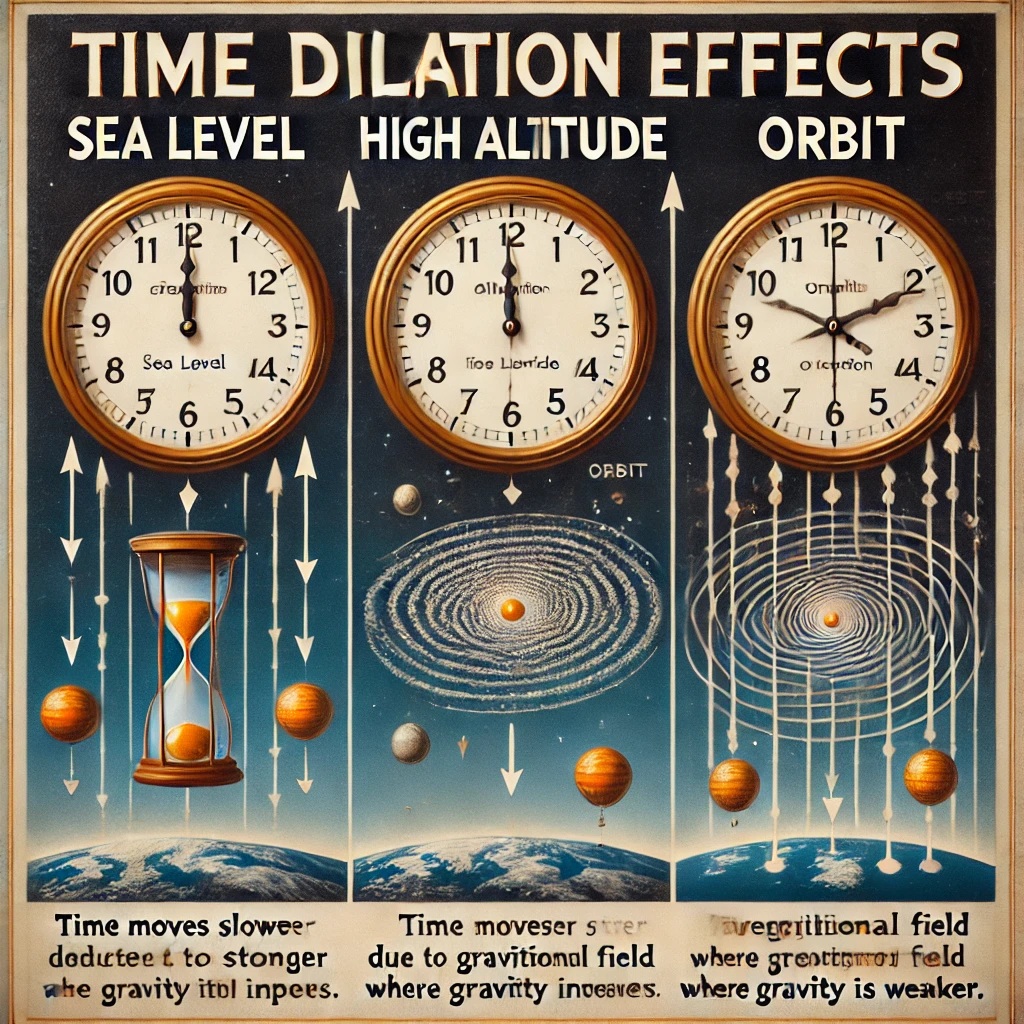
Time is not as constant as we might think. While we experience it as a steady progression of seconds and minutes, physics tells us otherwise. The force of gravity actually changes the scale of time, making it flow differently depending on where you are. This means that even in a tall building, time moves at slightly different rates between floors—though the effect is so small that only the most precise instruments can detect it.
Time and Gravity: A Subtle Distortion
Imagine you are sitting in a building with a regular wristwatch. The seconds tick by in a perfectly normal rhythm. However, if someone were sitting 10 floors above you, their time would be moving slightly faster than yours. The difference is incredibly tiny, but it exists.
This phenomenon is explained by Einstein’s General Theory of Relativity, which tells us that stronger gravitational fields slow down time. Since gravity is slightly weaker the higher up you go, time moves a little faster for someone on the upper floors compared to someone on the ground. A normal watch won’t detect this difference, but an atomic clock—one of the most precise timekeeping devices in existence—can measure this effect.
Where Does Gravity Come From?
You might wonder: Isn’t gravity strongest at the center of the Earth? At first glance, it seems logical—shouldn’t all mass pull toward the center, making it the most gravitationally intense point? However, this is a misleading idea.
Gravity is determined by the mass beneath you. The more mass below your feet, the stronger the gravitational pull. When you stand on the Earth’s surface, nearly the entire planet is beneath you, pulling you down. But as you descend closer to the core, more of the Earth’s mass surrounds you rather than pulling you in a single direction.
If you somehow made it to the exact center of the Earth, you would experience zero gravity. Why? Because the mass of the Earth would be pulling you equally in all directions, canceling out any net force. You wouldn’t feel any gravitational pull at all—it would be like floating in space.
The Universe Runs on Relativity
These effects are not just theoretical. Scientists have tested them using highly sensitive atomic clocks on airplanes, satellites, and mountain peaks. The results always confirm that time moves faster at higher altitudes and slower in stronger gravitational fields. This is also why satellites orbiting Earth must account for these time distortions to keep GPS signals accurate—without adjustments for gravitational time dilation, GPS devices would be off by kilometers!
Conclusion
Gravity does more than just keep us anchored to the ground—it shapes the very flow of time. The higher you go, the faster time moves, even if the difference is imperceptible in daily life. And if you could journey to the Earth’s core, you’d experience a world of zero gravity, where all forces cancel out. This is yet another way that the universe defies our everyday expectations, revealing the strange but fascinating nature of space, time, and gravity.
 Cosmic Watchers
Leave a comment