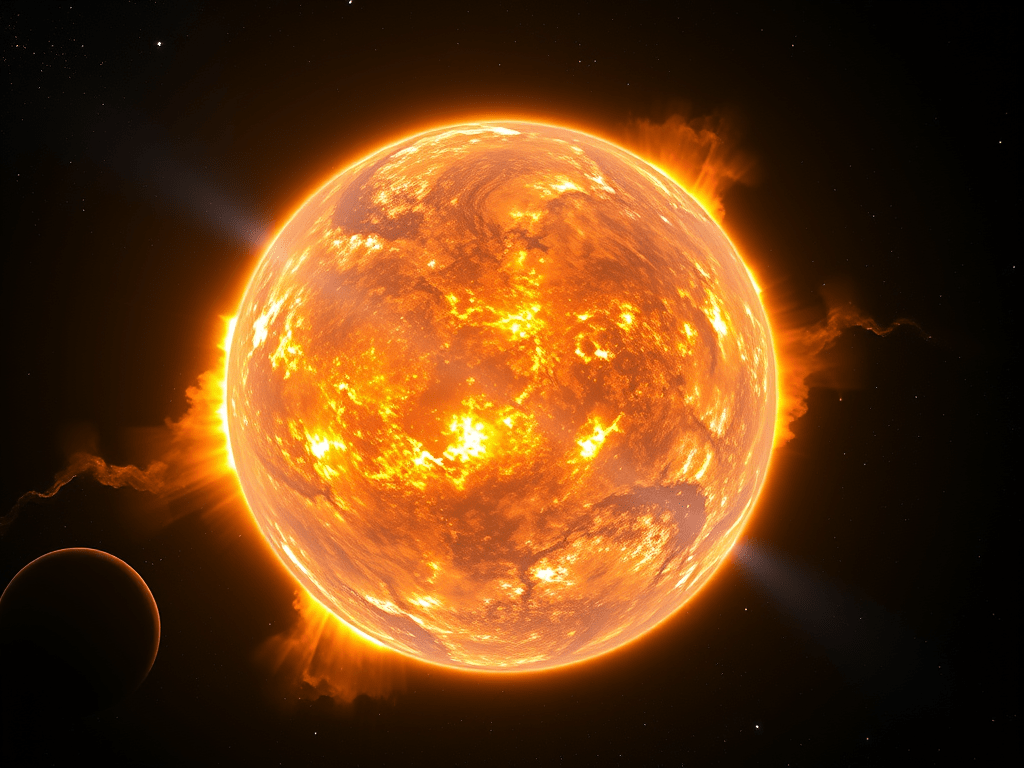
Why Are Stars Hot?
Stars are fiery giants because of gravity and nuclear fusion. If a mass of gas—at least 80 times Jupiter’s size—collapses under its own gravity, the intense pressure ignites fusion, turning hydrogen into helium and releasing enormous energy. This process generates immense heat and light, making stars shine for billions of years.
Planets vs. Stars
Planets, even massive ones like Jupiter, don’t have enough mass to trigger fusion. Brown dwarfs, which sit between planets and stars, can burn deuterium—a rare form of hydrogen—but never achieve full-fledged stellar fusion. This makes them dim compared to true stars.
No Small Stars, No Giant Planets
A star must be big enough to sustain fusion; anything smaller remains a planet or a brown dwarf. The difference is crucial—fusion is what makes a star a star. A planet, no matter how large, won’t spontaneously start burning unless it crosses the critical mass threshold. If a planet were to accumulate more than 80 Jupiter masses, the pressure and temperature at its core would trigger fusion, transforming it into a star.
The Heat of a Star
Once fusion begins, stars become incredibly hot. Red dwarfs, the smallest stars, hover around 3,000 K, while massive blue stars can exceed 40,000 K. The Sun, a mid-sized star, burns at about 5,778 K on its surface, with a core reaching a blistering 15 million K. This immense heat and radiation power everything from planetary climates to the very structure of galaxies.
Conclusion
Stars are hot because they fuse atoms under extreme pressure, generating vast amounts of energy. Without enough mass, fusion won’t start, and with too much, a planet inevitably becomes a star. This cosmic balance defines the boundary between planets and stars, ensuring that only the most massive celestial bodies can ignite and shine in the vastness of space.
 Cosmic Watchers
Leave a comment