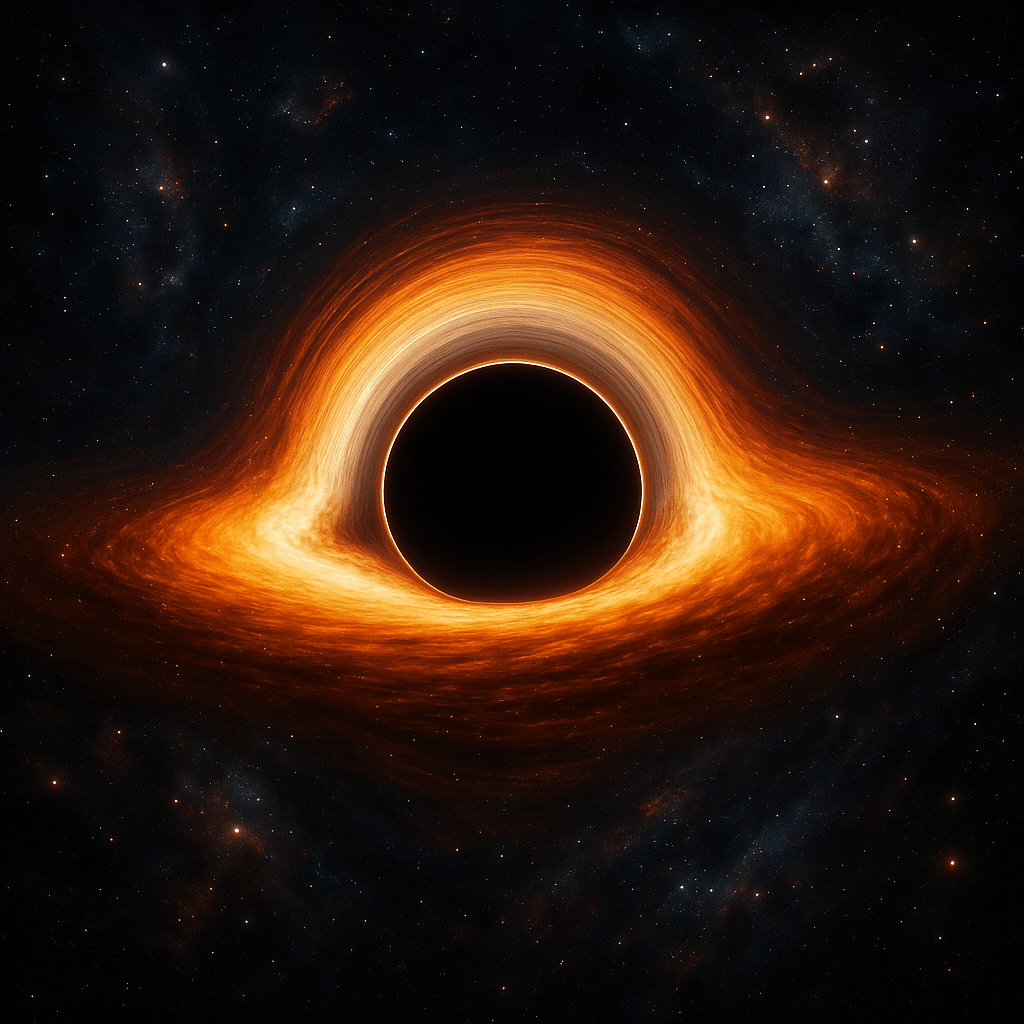
Imagine pointing your backyard telescope toward the constellation Cygnus on a crisp, clear night. You sweep across the starry sky and settle on a faint, twinkling point of light—a supergiant star known as HDE 226868. To your eyes, it’s just another star, a distant beacon in the cosmic sea. But here’s the twist: while you’re gazing at that star, you’re also brushing up against one of the universe’s most mysterious and powerful objects—a black hole. Welcome to Cygnus X-1, where the visible hides the invisible, and a stellar spectacle masks a cosmic abyss.
A Star with a Secret
Through your telescope, HDE 226868 looks like a typical blue supergiant, massive and radiant, glowing some 6,000 light-years away. But this star isn’t alone. It’s locked in a gravitational tango with an unseen partner—a black hole roughly 15 times the mass of our Sun. This dark companion, the heart of the Cygnus X-1 system, doesn’t glow or shimmer. It devours light itself, making it impossible to spot with even the sharpest backyard lens. Yet, its presence shapes everything you’re seeing.
Astronomers classify Cygnus X-1 as an X-ray binary—a dynamic duo where the black hole siphons gas from its stellar neighbor. As that gas spirals inward, it forms a blazing ring called an accretion disk, heating up to millions of degrees and firing off X-rays into space. Those X-rays are invisible to your telescope, but they’re the cosmic fingerprints that first tipped scientists off to the black hole’s existence back in 1964.
Seeing the Unseen
So, can you really “look at” a black hole through a telescope? Not directly—but you’re witnessing its handiwork. That star you’ve zeroed in on isn’t sitting still. It wobbles ever so slightly, tugged by the immense gravity of its invisible companion. If you could track its motion over months with precise measurements (beyond most amateur scopes, but not impossible with modern tech), you’d see the telltale signs of something massive pulling it off course. That “something” is the black hole, silently warping the space around it.
If your eyes could somehow tune into X-rays—like a superhero with cosmic vision—the scene would explode with drama. The accretion disk would blaze brighter than the star itself, a swirling inferno of light and energy spiraling toward the black hole’s event horizon, the point of no return. Even without that superpower, knowing it’s there transforms your quiet stargazing into a brush with the extreme.
A Cosmic Heavyweight
Cygnus X-1’s black hole isn’t just a curiosity—it’s a legend. When astronomers first studied this system in the 1970s, it became the first confirmed black hole ever, proving these bizarre objects weren’t just theoretical fantasies from Einstein’s equations. With a mass too great to be a neutron star, and no surface to emit light, it was the real deal: a stellar corpse collapsed into a gravitational pit so deep that nothing escapes.
Picture this: while you’re peering at that star, you’re indirectly staring into a region of spacetime so warped it bends reality itself. The black hole’s event horizon is a mere 44 kilometers across—tiny on cosmic scales—but its influence stretches across light-years, shaping the fate of its companion star and dazzling us with X-rays we’ve learned to detect with special telescopes.
A Glimpse into the Unknown
Next time you aim your telescope at Cygnus, take a moment to marvel. You’re not just looking at a star—you’re catching a glimpse of a black hole’s shadow, a force so powerful it rewrites the rules of the universe. Cygnus X-1 is a window into the wildest corners of existence, where gravity reigns supreme and the laws of physics get pushed to their limits. It’s a reminder that even in the stillness of a starry night, the cosmos is alive with secrets—some shining bright, others lurking in the dark, waiting for us to uncover them.
 Cosmic Watchers
Leave a comment