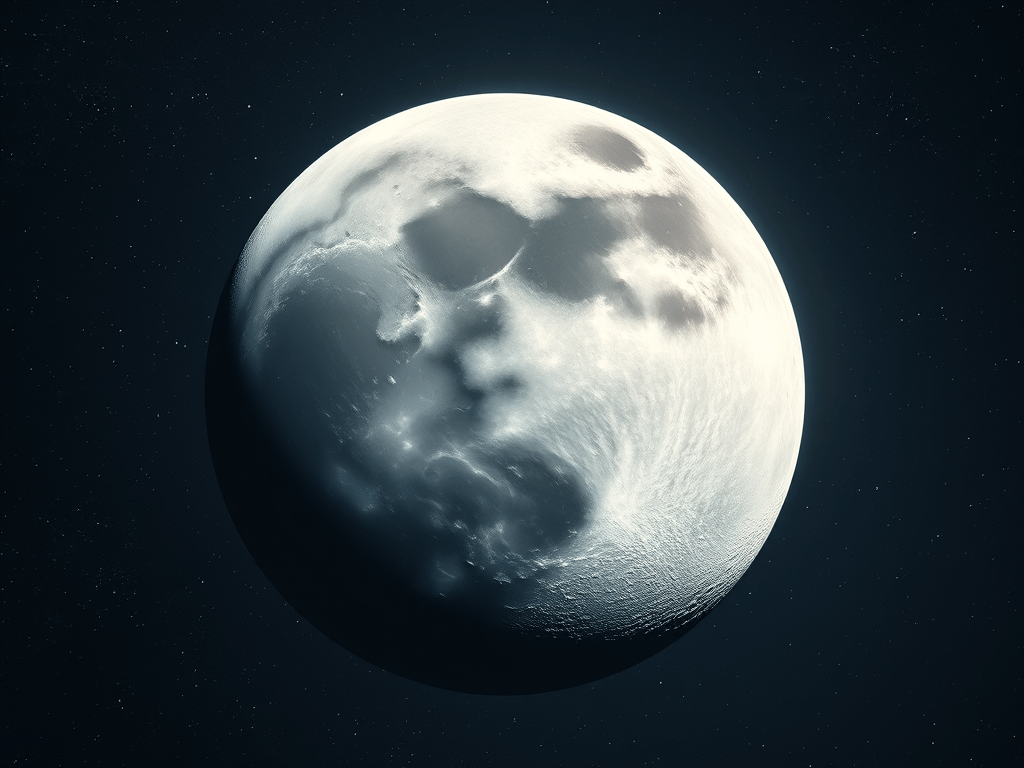
Every year, the Moon quietly slips a little farther from Earth—about 4 centimeters, to be exact. It’s a small shift, but over billions of years, this slow dance has changed the Moon’s place in our sky and left marks on its surface that hint at a dramatic past.
When the Moon first formed around 4.5 billion years ago, likely from debris caused by a massive collision between Earth and a Mars-sized object, it orbited much closer—some scientists estimate it was just 15,000 to 20,000 miles away, compared to the 238,855 miles it averages today. Back then, it would have loomed far larger in the sky, appearing several times the size we see now.
Because of this closeness, tidal forces between Earth and the Moon were extreme. Earth’s gravity slowed the Moon’s rotation until it became tidally locked—meaning the same side always faces us. But proximity also meant another thing: Earth was much hotter in its youth, still radiating the leftover heat of formation and heavy volcanic activity. That heat likely warmed the near side of the Moon more than the far side, which was turned away into the cold of space.
This temperature difference may have played a surprising role in the Moon’s landscape. A warmer surface would have had a thinner crust, making it easier for meteoroids and space debris to puncture and create the vast dark basins we see today—called maria—on the Moon’s near side. In contrast, the far side has a thicker crust and fewer maria, remaining rugged and heavily cratered.
Over time, as the Moon moved farther away, these early dynamics froze in place. The differences between the two hemispheres of the Moon are like a fossil record—a frozen story written in craters, cooled lava, and rock layers.
Even though the Moon continues to drift away at just 4 cm a year, that motion adds up. In a few billion years, solar eclipses as we know them—where the Moon perfectly covers the Sun—won’t happen anymore. The Moon will appear smaller in the sky, too far to fully eclipse the Sun.
For now, though, it still pulls on our tides, lights up our nights, and reminds us of just how dynamic our solar system once was—and still is.
 Cosmic Watchers
Leave a comment