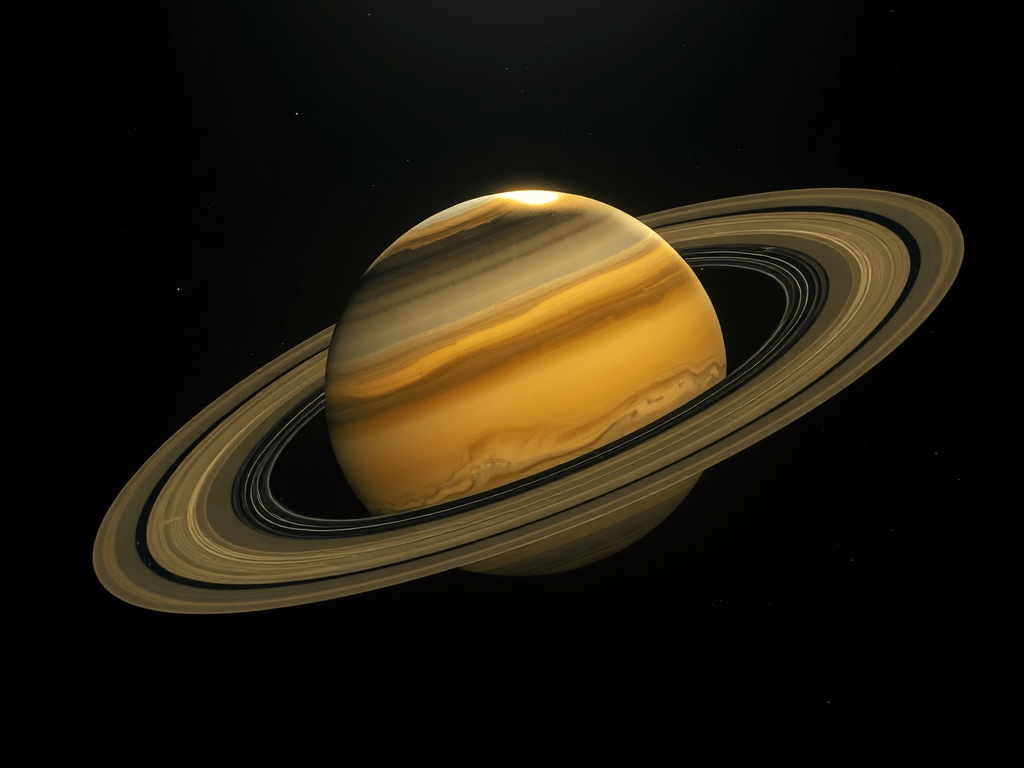
Traveling to Saturn sounds like the stuff of science fiction—massive rings glimmering in the blackness of space, a gas giant nine times wider than Earth, orbiting nearly a billion miles away. But what if we could travel to Saturn? Could we land on it? And if we tried… what would actually happen?
The Voyage to Saturn
Saturn is about 746 million miles (1.2 billion kilometers) from Earth. Even with our current fastest spacecraft, like NASA’s Parker Solar Probe, it would take several years to reach the ringed planet. Assuming advanced propulsion systems existed, a manned mission to Saturn might become feasible in the far future. But the real challenge begins after we arrive.
Can We Land on Saturn?
Short answer: No. Saturn has no solid surface.
Saturn is classified as a gas giant. Unlike Earth, Mars, or even the Moon, which have rocky surfaces you can walk on, Saturn is made mostly of hydrogen and helium gas, surrounding a core that may be rocky or metallic—but we don’t know for sure. The outer layers are thick clouds and deep, dense atmosphere. If you tried to “land,” you’d just keep falling… and falling… and falling.
What Happens If You Try to Land?
Let’s imagine a spacecraft enters Saturn’s upper atmosphere:
- Entry and Descent: As you descend, the pressure increases rapidly. The upper clouds might seem calm, but below them lies a turbulent storm system with winds blowing at over 1,000 mph (1,600 km/h). Lightning bolts larger than any on Earth flash in the thick clouds.
- Crushing Pressure: As you go deeper, the atmosphere becomes denser. Eventually, the pressure becomes astronomical—thousands of times greater than what we experience on Earth. Any unprotected craft or human would be crushed long before reaching the core.
- Extreme Temperatures: Not only does pressure increase, but so does temperature. Deep within Saturn, temperatures can rise to tens of thousands of degrees Fahrenheit, enough to melt or vaporize most materials.
- No Surface to Land On: Even if your spacecraft survived the pressure and heat, there’s no solid ground to land on. The deeper layers become more like a thick fluid or metallic hydrogen, not something you could set a spacecraft on.
Could We Take Off Again?
Assuming we had a ship strong enough to survive part of the descent, escaping from Saturn would be incredibly difficult. Saturn’s gravity is much stronger than Earth’s—you’d need an enormous amount of fuel and power to lift off against it, especially from deep in the atmosphere where drag and pressure are extreme.
Also, because there’s no solid surface, you can’t “launch” from a platform. You’d need a ship that can fly and maneuver within a crushing, stormy atmosphere—something we don’t yet have the technology for.
Would We Be Squished by Gravity?
You wouldn’t be crushed just by Saturn’s gravity alone from orbit or afar. The real danger is pressure inside the planet’s atmosphere. Gravity only becomes a deadly force if you try to descend into Saturn itself. Even robotic probes, like the Galileo probe that entered Jupiter’s atmosphere (a gas giant similar to Saturn), were destroyed by the increasing pressure and heat long before they reached the core.
What Could We Do Instead?
Even though landing is impossible, Saturn’s moons offer a much better target.
- Titan, Saturn’s largest moon, has a thick atmosphere and lakes of methane. It’s one of the most Earth-like bodies in the Solar System.
- Enceladus, another Saturnian moon, has geysers that shoot water vapor into space—possibly from an underground ocean.
These moons could be visited, landed on, and even colonized in the distant future.
Final Thoughts
Saturn is a breathtaking planet to study, but not a place we can land. Without a solid surface and with crushing atmospheric conditions, Saturn itself is more of a death trap than a destination. However, its many fascinating moons are calling out for exploration. So while humans may never set foot on Saturn, the ringed giant still holds plenty of secrets for us to uncover—from a safe distance.
 Cosmic Watchers
Leave a comment