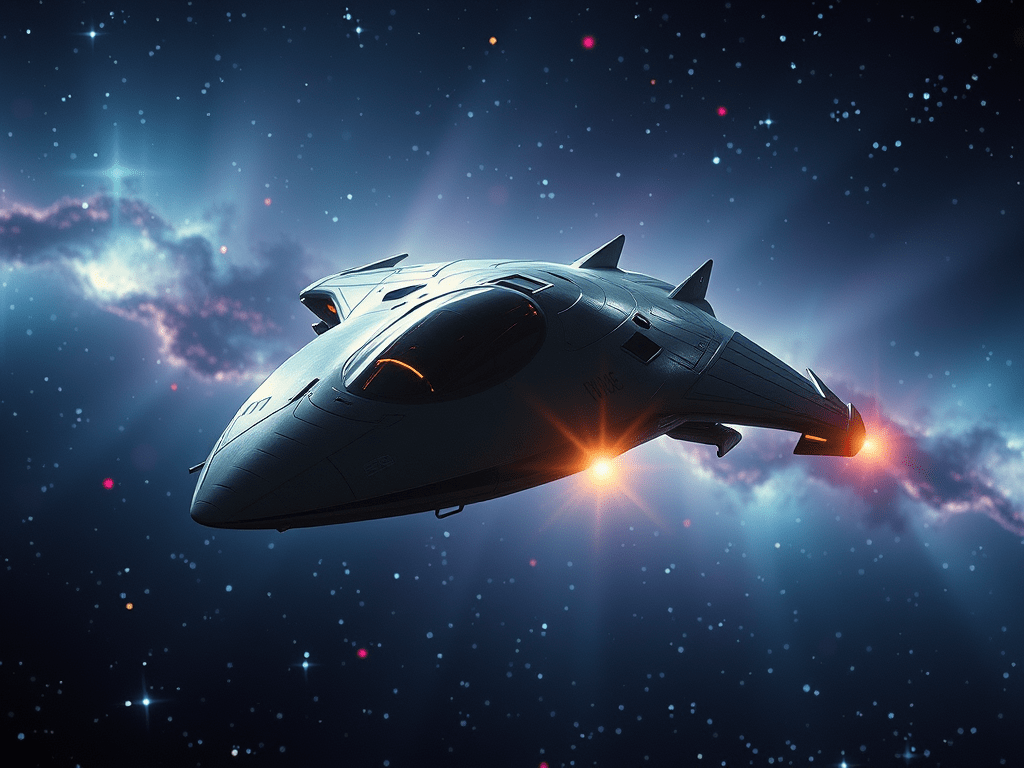
For decades, science fiction has imagined humanity sailing between the stars. From warp drives to wormholes, these fantastical concepts captured the imagination. But today, space agencies and private companies are turning dreams into blueprints. The big question remains: how close are we, really, to interstellar space travel?
The Challenges of Getting There
Let’s start with the brutal truth: the nearest star system, Alpha Centauri, is over 4.3 light-years away. Even our fastest spacecraft, like Voyager 1, would take over 70,000 years to reach it.
Why? Because we’re limited by current propulsion technology. Rockets like the Falcon 9 or NASA’s SLS are powerful—but slow when it comes to cosmic distances. We need new methods of propulsion that break past these limits.
Breakthroughs on the Horizon
Fortunately, new ideas are gaining traction:
- Nuclear Thermal and Nuclear Electric Propulsion: These systems promise more efficiency and power than chemical rockets. NASA has been testing concepts like these for future Mars missions.
- Light Sail Technology: The Breakthrough Starshot project proposes sending tiny probes to Alpha Centauri using laser-powered light sails. These could theoretically reach 20% the speed of light, cutting the journey to just over 20 years.
- Fusion Propulsion: Think of a mini star onboard a spacecraft. Fusion propulsion, still in development, could drastically increase travel speed and energy efficiency. Projects like Helicity Drive and Project Daedalus are exploring this route.
Artificial Intelligence Will Lead the Way
Before sending humans, we’ll likely send advanced AI-driven probes. These robotic explorers can handle long journeys, communicate across vast distances, and make decisions without waiting for instructions from Earth—a necessity when signals take years to arrive.
Time Dilation: A Twist of Physics
Einstein’s theory of relativity tells us that as you approach the speed of light, time slows down for you relative to observers on Earth. So if we ever build ships fast enough, astronauts could age much slower than people back home. That’s both a perk and a profound psychological challenge.
So, Are We Close?
In short: no, we’re not close to crewed interstellar travel—yet. But we’re making meaningful steps toward it. The coming decades may see robotic probes sent to nearby stars, laying the groundwork for future human missions.
Space travel is still in its infancy, but each mission—whether to the Moon, Mars, or beyond—brings us a little closer to the stars.
 Cosmic Watchers
Leave a comment