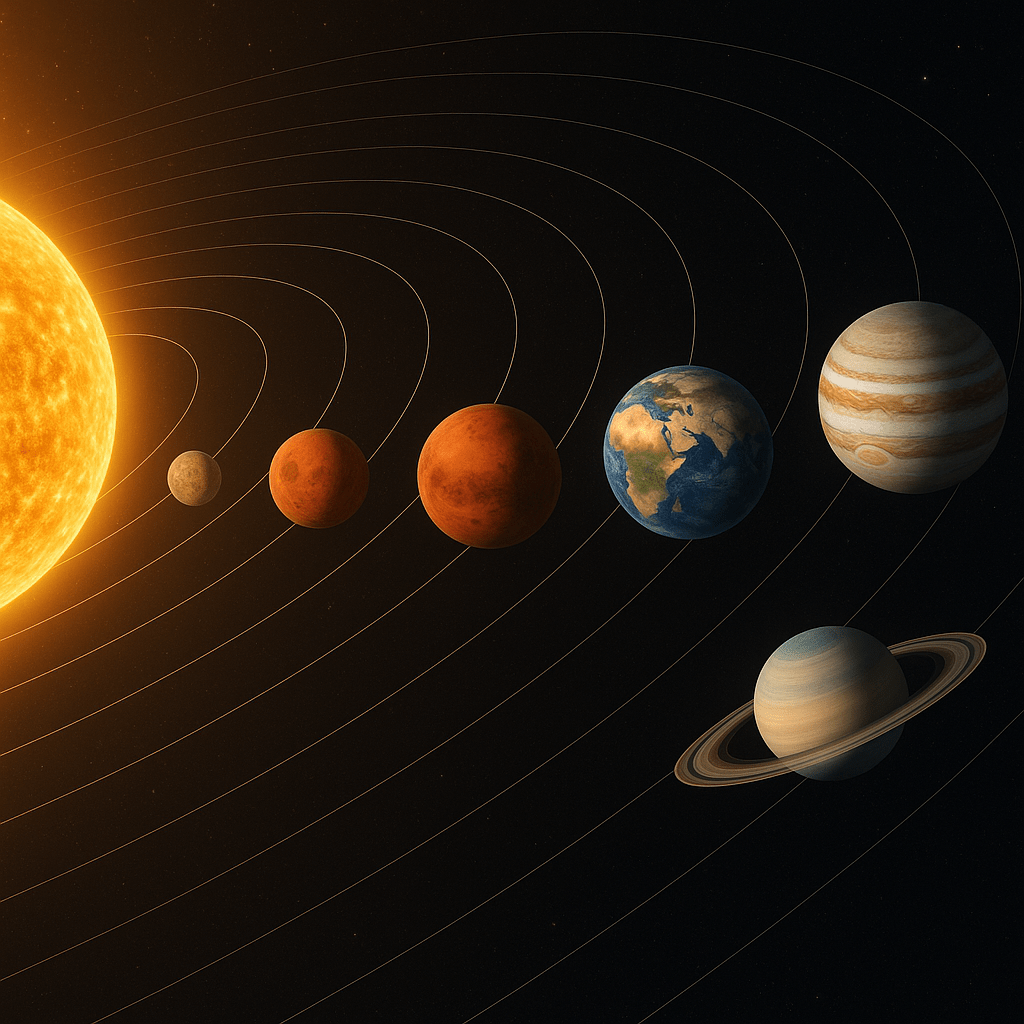
Imagine waking up on a planet that’s no longer in the same neighborhood of the solar system. Earth is now the fourth planet from the Sun, and Mars has taken Earth’s current place as the third. This planetary swap might sound like science fiction, but it opens up fascinating possibilities—and terrifying consequences. Let’s explore what might happen if Earth and Mars switched orbits.
The Orbital Shift: Earth Moves Outward, Mars Moves Inward
In our current solar system, Earth orbits the Sun at an average distance of 93 million miles (150 million kilometers), placing it comfortably in the “habitable zone”—where temperatures allow liquid water to exist. Mars, farther out at about 142 million miles (228 million kilometers), is colder, drier, and more hostile.
If Earth and Mars swapped places:
- Earth would now orbit at Mars’ colder, more distant location.
- Mars would enjoy a warmer position closer to the Sun.
But would that make Mars more habitable—and Earth less so?
What Happens to Earth?
Once Earth takes Mars’ place at the fourth position from the Sun, the consequences would be dramatic.
1. Global Cooling Begins
At its new distance, Earth would receive only about 43% of the solar energy it currently gets. That means the average surface temperature would plummet. Polar regions would rapidly expand, equatorial zones would freeze, and much of the planet would become inhospitable.
2. Collapse of Ecosystems
Photosynthesis would slow down due to the reduced sunlight, weakening food chains. Crops would fail. Weather systems would shift drastically. Most life forms that rely on current Earth-like conditions would be unable to survive.
3. Atmosphere Begins to Change
As the planet cools, more carbon dioxide and water vapor would be trapped as ice. This would reduce the greenhouse effect, accelerating the freeze. Earth could begin to resemble a giant snowball, similar to what scientists believe happened during Earth’s ancient “Snowball Earth” periods.
4. Oceans Freeze
Without enough warmth, the oceans could begin to freeze over—starting at the poles and creeping toward the equator. Surface ice would expand, potentially insulating deeper liquid water for a while, but life in those waters would be severely threatened.
What Happens to Mars?
Now orbiting closer to the Sun, Mars would benefit from the added warmth—but that doesn’t mean it would suddenly become a second Earth.
1. Warming Up
With nearly double the sunlight it used to receive, Mars would warm up. Surface temperatures could rise enough to melt some of its frozen carbon dioxide and water. This could trigger a partial greenhouse effect, thickening its thin atmosphere and warming the planet further.
2. Temporary Climate Boost
The extra energy might cause brief periods of surface water flow, cloud formation, and seasonal weather patterns. Dust storms could become more intense. In short, Mars would look more Earth-like—but only slightly.
3. Still No Magnetosphere
One major issue remains: Mars lacks a global magnetic field. Even with more sunlight and a thicker atmosphere, solar radiation would continue stripping its air away over time. Without a strong magnetic shield, long-term habitability remains unlikely.
Would Life Survive the Swap?
On Earth:
- Humans and animals would struggle to survive without advanced technology.
- Plants adapted to cold might hang on for a time, but most agriculture would collapse.
- Survival would depend on artificial heating, energy storage, and underground habitats.
On Mars:
- While Mars might become more habitable, it wouldn’t become fully habitable.
- Colonies with the right infrastructure might benefit from the warmer climate.
- Terraforming efforts would have a better starting point—but would still take centuries or millennia.
A Solar System Rebalanced?
Interestingly, this swap could lead to a solar system where:
- Earth becomes a frozen world—possibly sustaining microbial life under ice, like Jupiter’s moon Europa.
- Mars becomes a “near-miss” Earth—more Earth-like than before but still needing serious help to support life.
It also raises questions about how planetary position affects life, evolution, and climate. Earth is not just special because of where it is—but because of a long list of finely tuned variables that include its magnetic field, atmosphere, tilt, rotation speed, plate tectonics, and more.
Final Thoughts
The idea of Earth and Mars switching orbits is a fascinating thought experiment that underscores how delicate the conditions for life really are. A change in solar distance—even by tens of millions of miles—could render Earth lifeless and give Mars only a small, temporary shot at habitability.
It reminds us that we live on a rare and precious world, perfectly balanced in its cosmic neighborhood. A slight shift in orbit, and everything we take for granted—oceans, forests, blue skies, and breathable air—could vanish into frozen silence.
The next time you look up at the red dot in the night sky, remember: it could have been us.
 Cosmic Watchers
Leave a comment