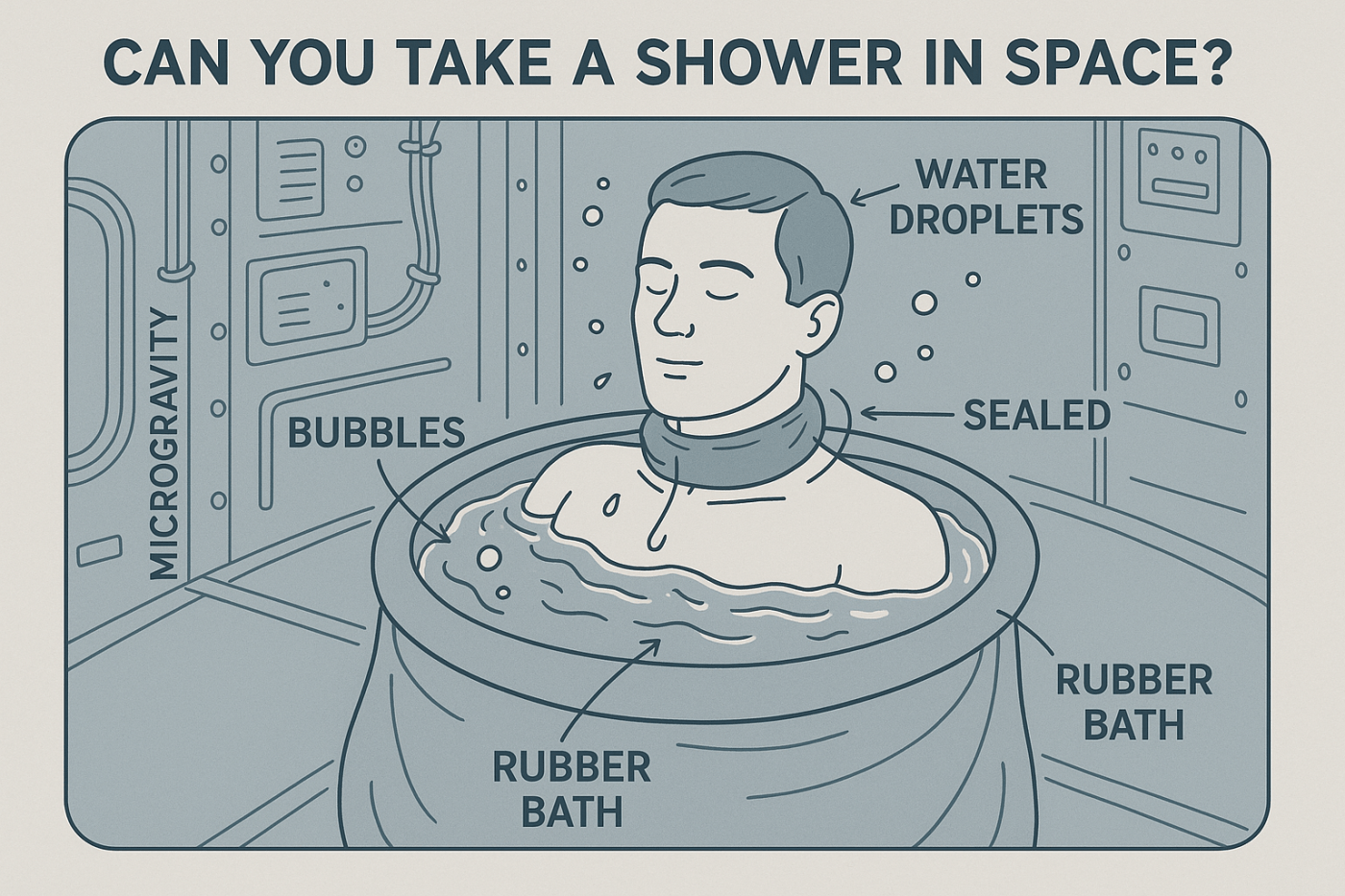
We take showers for granted here on Earth, where gravity obediently pulls water downward and drains whisk it away. But what happens when you leave gravity behind? Can astronauts take showers in space? Could they even climb into a water-filled rubber bath like on Earth? The answers are both fascinating and a little weird.
Hygiene in Orbit: No Real Showers
On the International Space Station (ISS), astronauts do not take traditional showers. Water doesn’t fall—it floats. If you tried to turn on a normal showerhead, water would bead up and drift away in globules, potentially damaging electronics or being inhaled. Because of this, hygiene routines in space are closer to what we might call a “sponge bath.”
Astronauts use rinseless wipes, no-rinse shampoo, and wet towels to clean themselves. They squirt small amounts of water onto their skin and wipe it away, taking care not to let moisture float off into the cabin.
Why Not Just Build a Shower?
NASA did experiment with a makeshift shower on Skylab in the 1970s. It looked like a tall cylinder with a plastic curtain. Astronauts sprayed water and vacuumed it up with a hose afterward. While it worked, it was bulky, time-consuming, and impractical for the tighter, more modern ISS. Space, weight, and complexity are always critical considerations.
What About a Sealed Rubber Bathtub?
It’s an interesting idea: a rubber bath that seals around the astronaut’s neck, holding water inside so it doesn’t escape. But this design comes with several major challenges:
- Water containment is tricky. Even if sealed well, bubbles and droplets can escape when you enter or exit.
- Surface tension dominates in microgravity. Water clings to surfaces (and skin) in unpredictable ways. You might end up coated in a stubborn water film that refuses to drip off.
- Clean-up is a nightmare. You’d need a suction system to remove the water, clean the tub, and handle humidity—all using power and storage resources better used elsewhere.
- Bacterial growth risk. A warm, humid space bath could become a breeding ground for bacteria or mold if not sterilized thoroughly after each use.
In short, a sealed rubber bath might be technically possible, but it’s not practical—at least with current space station design philosophies.
The Future of Space Showers
Looking ahead, longer missions—like those to Mars—will require better hygiene solutions. Some concepts include:
- Closed-loop showers that recycle and purify water.
- Ultrasonic or air-jet cleaning systems that remove grime without much liquid.
- 3D-printed hygiene pods tailored for individual crew members.
NASA and other space agencies are researching these ideas now. Comfort and cleanliness matter for astronaut health and morale, especially on deep space journeys lasting months or even years.
Conclusion
So no, astronauts don’t relax in steamy showers or soak in space bathtubs. Instead, they rely on creative, low-water hygiene techniques. While your rubber bath idea sounds cozy, gravity-free bathing is a puzzle still waiting for an elegant, efficient solution. For now, floating showers remain the stuff of science fiction—but who knows what future missions might bring?
 Cosmic Watchers
Leave a comment