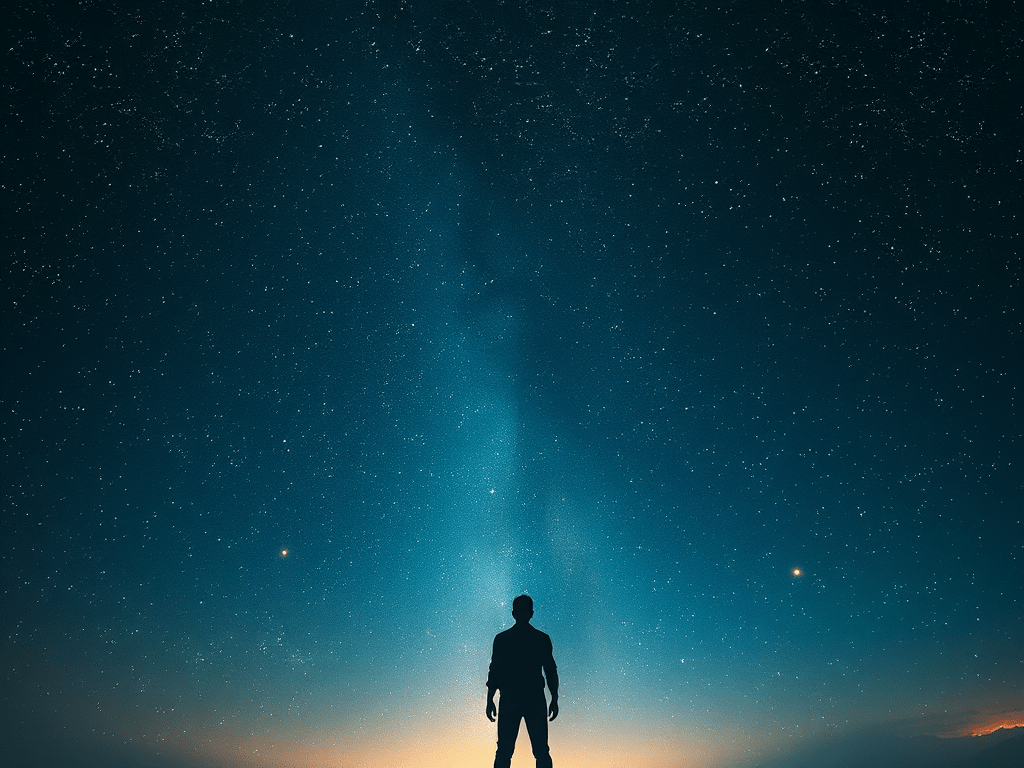
When we gaze up at the stars, we assume we are late to the party.
The universe is ancient—more than 13.8 billion years old. Our Sun, in contrast, is a mere 4.6 billion years old, and humanity has existed for only the final blink of that span. Surely, we reason, if life could arise here, it must have arisen countless times before elsewhere.
But what if it didn’t?
What if we are not the latest guests to arrive—
…but the first?
A Young Fire in an Old Forest
At first glance, the idea seems arrogant. How could we, a species still stumbling through adolescence, be the first intelligent civilization to awaken in the cosmos?
And yet some astrophysicists and philosophers have proposed just that.
Known as the Firstborn Hypothesis, this theory suggests that life—especially intelligent life—may take far longer to emerge than we assume, and that conditions necessary for complex civilizations may only now be becoming common.
In other words: the stars may be ancient, but the stage may have only just been set.
Waiting for the Right Conditions
Early in the universe’s history, the cosmos was a dangerous place. The first generations of stars were massive, unstable, and short-lived. Supernovae and gamma-ray bursts were far more common. Heavy elements—like carbon, oxygen, iron, and phosphorus—had to be forged over billions of years in stellar furnaces.
Planets like Earth, rich in these ingredients, are a relatively new phenomenon.
The universe may have needed billions of years of chemical seasoning before the recipe for life was even possible. And even then, it took another few billion years for single-celled life to become complex, and complex life to become intelligent.
Now, finally, the oven is warm enough.
And perhaps… we are the first loaf to rise.
The Quiet Weight of Being First
The implications of being the first are sobering.
It means there are no older civilizations watching over us. No ancient wisdom to call upon. No mentors—only silence.
We may be the seed, not the fruit.
The builders, not the inheritors.
It also means that the responsibility is ours. If we are the first, then everything we do—our triumphs, our failures, our dreams—may ripple into a future cosmic culture yet unborn. If we destroy ourselves, we may close the door on a billion futures that will never be.
Being first means being remembered—or being lost forever.
But How Would We Know?
If we are truly the first, the universe would appear exactly as it does now—vast, old, and empty of voices.
Radio telescopes would hear only the sigh of quasars.
The stars would shine without reply.
The Great Silence would simply be… the beginning.
Even the so-called “Wow!” signal, or ʻOumuamua, would be nothing more than random noise and drifting rock—because no one else is speaking yet.
And in that silence, our signals—our television broadcasts, our radar pings, our Voyager probes—would be the first footprints on an untouched beach.
A Burden and a Blessing
Some might find this idea lonely. Others, inspiring.
To be first is to walk unguarded into the unknown. It is to write the opening lines of a story that may stretch across millennia and galaxies.
It means that we must be the elders for civilizations yet to form—on planets not yet cooled, under stars not yet born.
Perhaps one day, a distant world will point a dish toward the heavens and hear us.
And they will wonder, “Who came before?”
In the End…
Maybe we are not one of many.
Maybe we are not even early.
Maybe… we are the first.
And if so, then we must watch with care, act with humility, and build with purpose.
Because the watchers of the cosmos might not be waiting for us—
…they may yet be born from us.
Until then, we at Cosmic Watchers will keep listening, and keep watching.
 Cosmic Watchers
Leave a comment