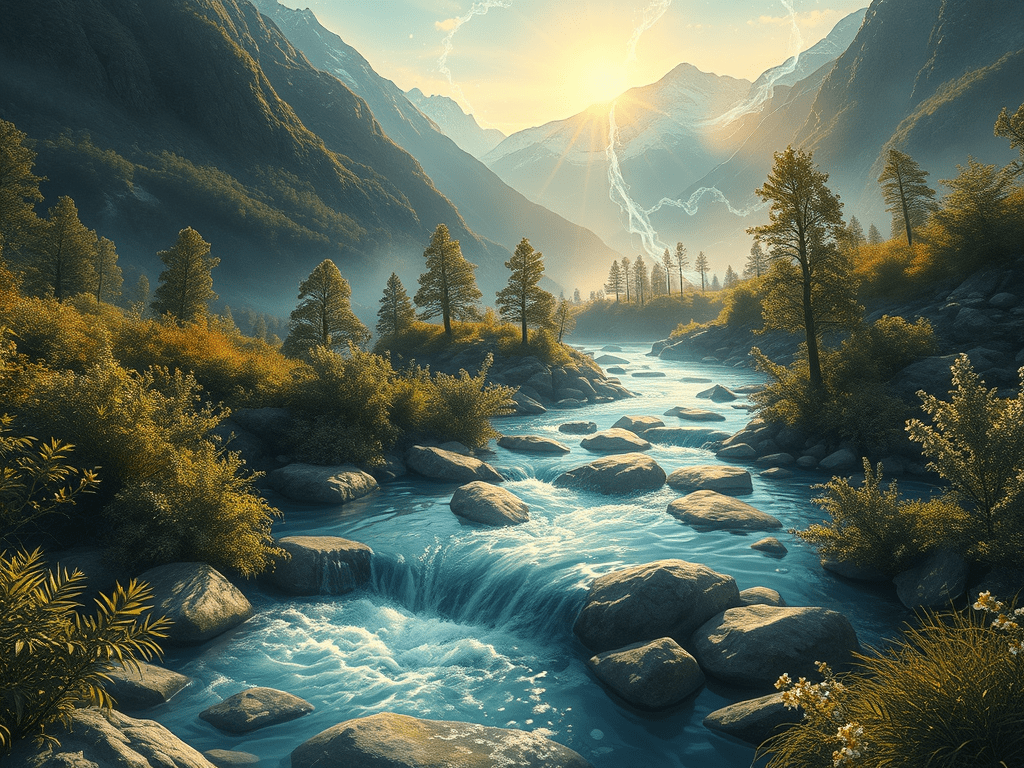
Since the earliest days of civilization, people have followed rivers upstream, seeking their source. The place where a river begins—its headwaters—is often a hidden spring, a melting glacier, or a lake nestled high in the mountains. These beginnings, humble and remote, have always carried a sense of reverence. In many cultures, the source of a river was considered sacred—something close to the divine.
But what if the story of a river begins even earlier, and much farther away?
As we explore space, we find that flow is not unique to Earth. There are streams of plasma arching over the surface of the Sun, currents of gas and dust between stars, and even rivers of stars guided by gravity through our galaxy. These celestial flows may not carry water, but they follow the same timeless principle: motion shaped by natural forces.
Remarkably, water itself exists in space. Astronomers have discovered massive clouds of water vapor near distant stars, and comets—often called “dirty snowballs”—carry ice across the solar system. Some scientists believe that Earth’s water may have come from these cosmic travelers, meaning the stream behind your house might trace its origins back to the stars.
So while a river may begin at a quiet spring in the forest, its story is ancient and universal. From the mountains to the Milky Way, nature seems to favor the path of flow—of beginning in one place and journeying toward another.
In that sense, every river is both earthly and celestial. A reminder that even here, in the quiet places of Earth, we are touched by the wider cosmos.
 Cosmic Watchers
Leave a comment