If any civilization could be called masters of time, it was the Maya. Living in Mesoamerica over a thousand years ago, they built towering temples, advanced cities, and most famously, a calendar system so precise it still amazes researchers today. For the Maya, the heavens were not distant lights but active forces shaping the destiny of kings, crops, and even entire eras.
The Astronomer-Priests
The Maya carefully observed the sky from structures that functioned as observatories, such as El Caracol at Chichén Itzá. Its round tower allowed priests to track the movement of the sun, moon, and especially the planet Venus. Venus wasn’t just a bright point in the night sky — it was a cosmic actor tied to war, agriculture, and prophecy.
They also predicted solar and lunar eclipses with astonishing accuracy, something that demanded generations of detailed record-keeping. Their Long Count calendar tracked cycles spanning thousands of years, far beyond the needs of daily life — showing just how deeply they thought about cosmic time.
Gods and Visitors from the Sky
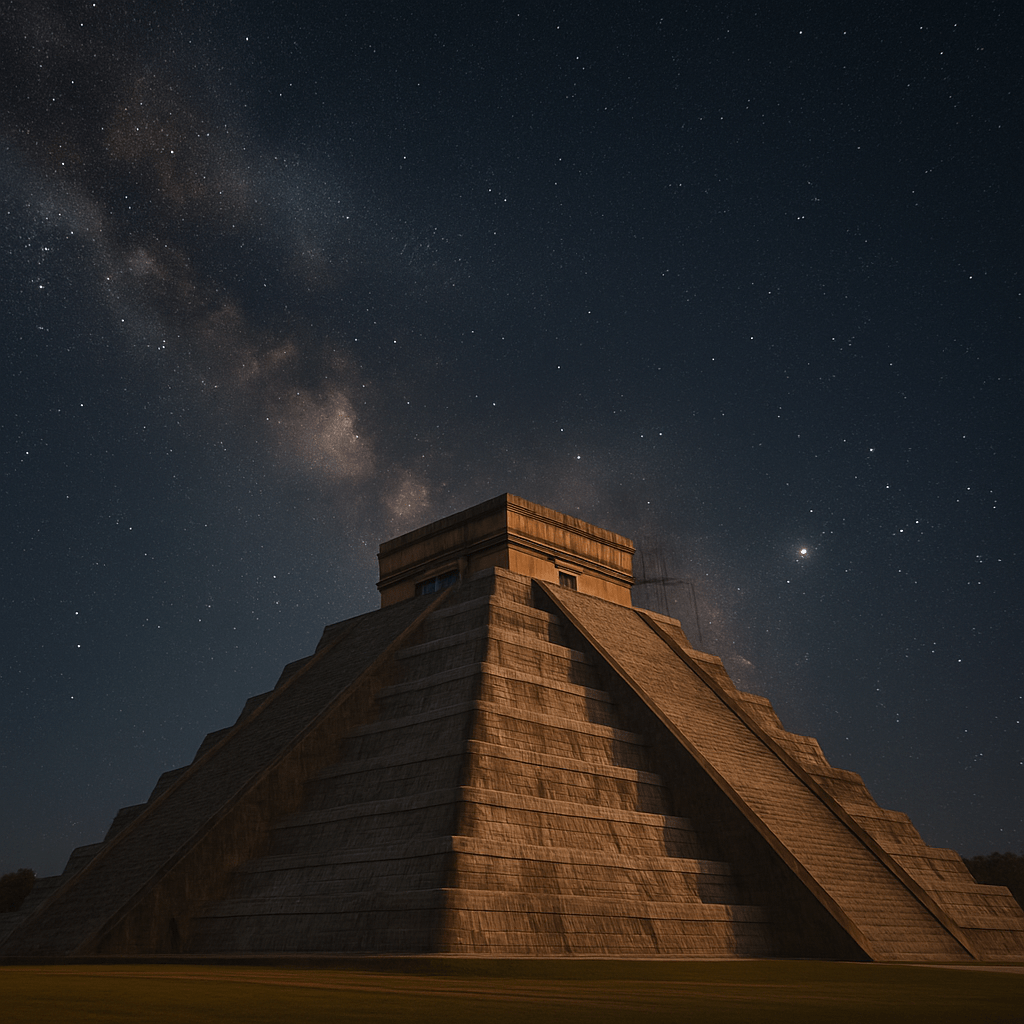
Maya mythology is filled with stories of beings who descended from above. One of the most famous figures is Kukulkan, the feathered serpent god who came from the sky to bring knowledge and order. Each equinox at Chichén Itzá, sunlight creates the illusion of a serpent slithering down the pyramid of El Castillo — a dramatic blend of architecture and astronomy that still draws crowds today.
While historians see these as symbolic myths, some wonder whether such “sky-beings” could represent encounters with something beyond the ordinary. Were they simply gods of imagination, or memories of visitors who came from the heavens long ago?
Time, Stars, and Mystery
The Maya saw time itself as cyclical, with cosmic ages beginning and ending in great cycles. This worldview makes sense when looking at the repeating motions of the heavens, yet it also adds an aura of mystery. What inspired such long-range thinking? Did they believe they were recording the rhythms of gods, or mapping the order of the universe as it truly is?
Legacy of the Cosmic Calendar
Today, much has been said — and misunderstood — about the Maya calendar. While modern myths about “doomsdays” have been exaggerated, the truth is no less impressive: the Maya were among the finest astronomers of the ancient world. Their legacy reminds us that humanity’s urge to understand the sky is both scientific and spiritual, logical and mysterious.
In the next installment of Ancient Skies, we’ll cross the world to explore the legends and alignments of the Americas — from the Hopi stories of sky messengers to the giant geoglyphs of the Nazca lines.
 Cosmic Watchers
Leave a comment