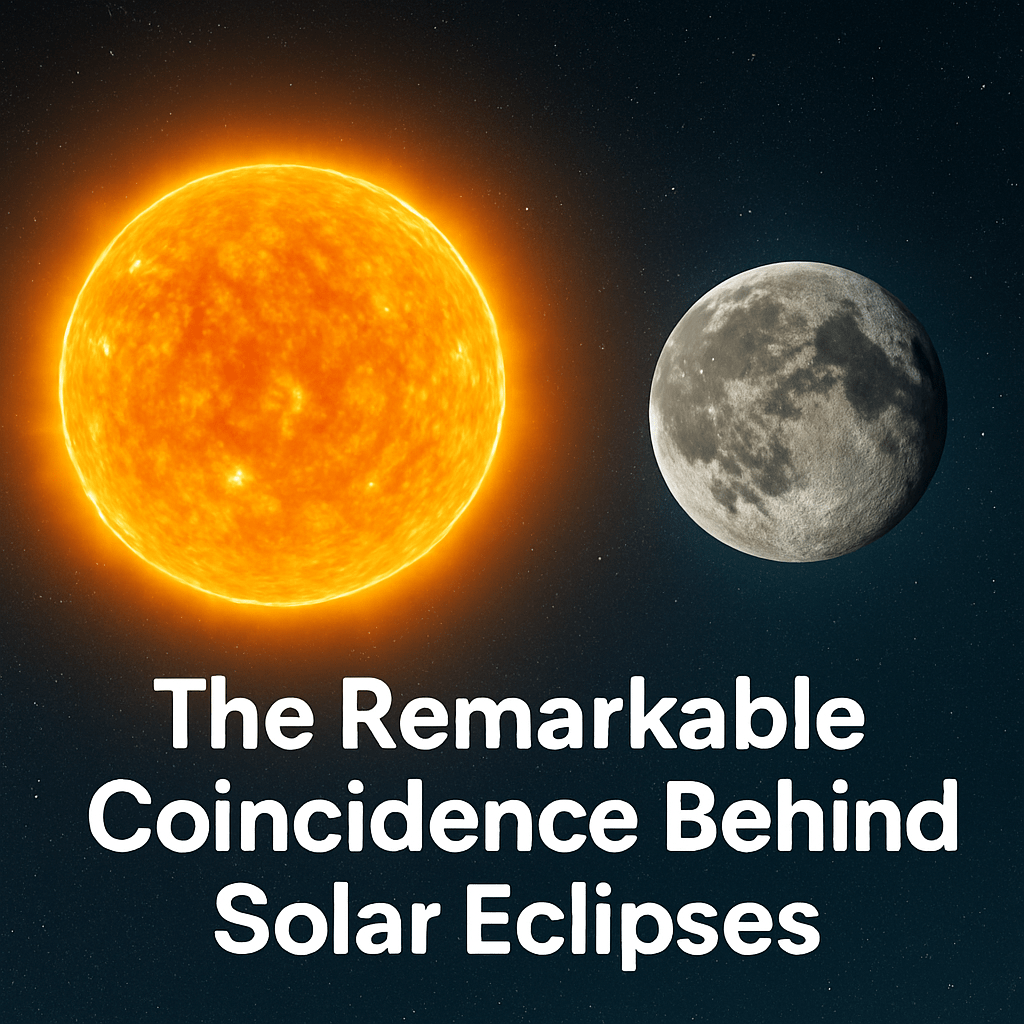
For as long as people have watched the sky, the Sun and Moon have shaped our sense of time, season, and wonder. Among all the sights our ancestors passed down through stories and observations, few feel as striking—and almost uncanny—as a total solar eclipse. One simple astronomical coincidence makes it possible: the Moon appears almost exactly the same size in the sky as the Sun.
This happens because the Moon is about 1/400th the size of the Sun while also being about 1/400th as far from Earth. Those two ratios line up so precisely that the Moon can cover the Sun’s face with a near-perfect fit. No other known planet-moon combination in our solar system shares this balance.
Most moons are either too small or too distant to create such a perfect eclipse. Others are too large and would block their star entirely if viewed from their host planets. Earth’s situation sits in a narrow, almost delicate middle ground.
Why This Alignment Matters
Because the sizes match so closely, total solar eclipses reveal sharp, detailed features: the Sun’s shimmering corona, stars emerging in the daytime, and the shadow sweeping across Earth with a crisp edge. If the Moon were even slightly smaller or farther away, we would see only annular “ring of fire” eclipses. If it were larger or closer, the corona would vanish from view.
This balance isn’t permanent. The Moon drifts 3.8 centimeters farther from Earth every year. In the far future, total eclipses will fade into history as the Moon becomes too small in the sky to cover the Sun completely.
What Happens as the Moon Drifts Away?
1. Total Eclipses End
Tens of millions of years from now, the Moon will appear too small to block the Sun fully. Only annular eclipses will remain.
2. Tides Weaken
The Moon’s gravity drives the tides. As it moves farther out:
- High tides will become lower
- Low tides will become higher
- Coastal life depending on strong tidal cycles will slowly adapt or disappear
Earth’s shores will change in character with time.
3. Earth’s Tilt Becomes Less Stable
The Moon acts as a stabilizer. Without its strong influence, Earth’s tilt could wander more, leading to:
- Greater long-term climate swings
- Possible shifts between colder and warmer eras
- Less predictable seasons over geological timescales
Life could still exist, but the planet’s personality would be different.
4. Days Grow Longer
As Earth’s rotation slows over immense spans of time, one day could last 30 hours or more. Weather patterns and biological rhythms would shift accordingly.
5. Will Life Exist After the Moon Is Gone?
Life can exist without a moon. Many planets, if they host life, likely do so without a large companion in the sky.
But on Earth, the Moon’s retreat won’t be the deciding factor. The Sun will change long before the Moon fully escapes. Within 1–2 billion years, the Sun will brighten enough to make Earth uninhabitable. In other words:
- Life ends because of the Sun
- Not because of the Moon drifting away
The Moon’s gradual departure simply reshapes Earth, not its ultimate fate.
A Farewell Written in Slow Motion
The Moon has been a constant companion for billions of years and will remain one long after humanity is gone. Its slow outward drift is not a dramatic event but a quiet, steady change written into the mechanics of the solar system.
And we happen to live at the perfect moment—an era where eclipses still turn day into night and the Sun’s corona still shines for us to see.
A Reminder for Those Who Watch the Sky
As ages pass and the heavens shift, one thing remains: humanity has always looked upward. Long before modern astronomy, people studied the sky through tradition, patience, and simple observation.
We live in a rare chapter of Earth’s story, one where the Moon still matches the Sun so precisely that it creates the most dramatic eclipses our world will ever see.
In moments like these, it’s worth remembering who we are.
We are the ones who pay attention. We are the sky-watchers.
And as long as the universe keeps moving, we should keep watching, just as those before us did.
 Cosmic Watchers
Leave a comment