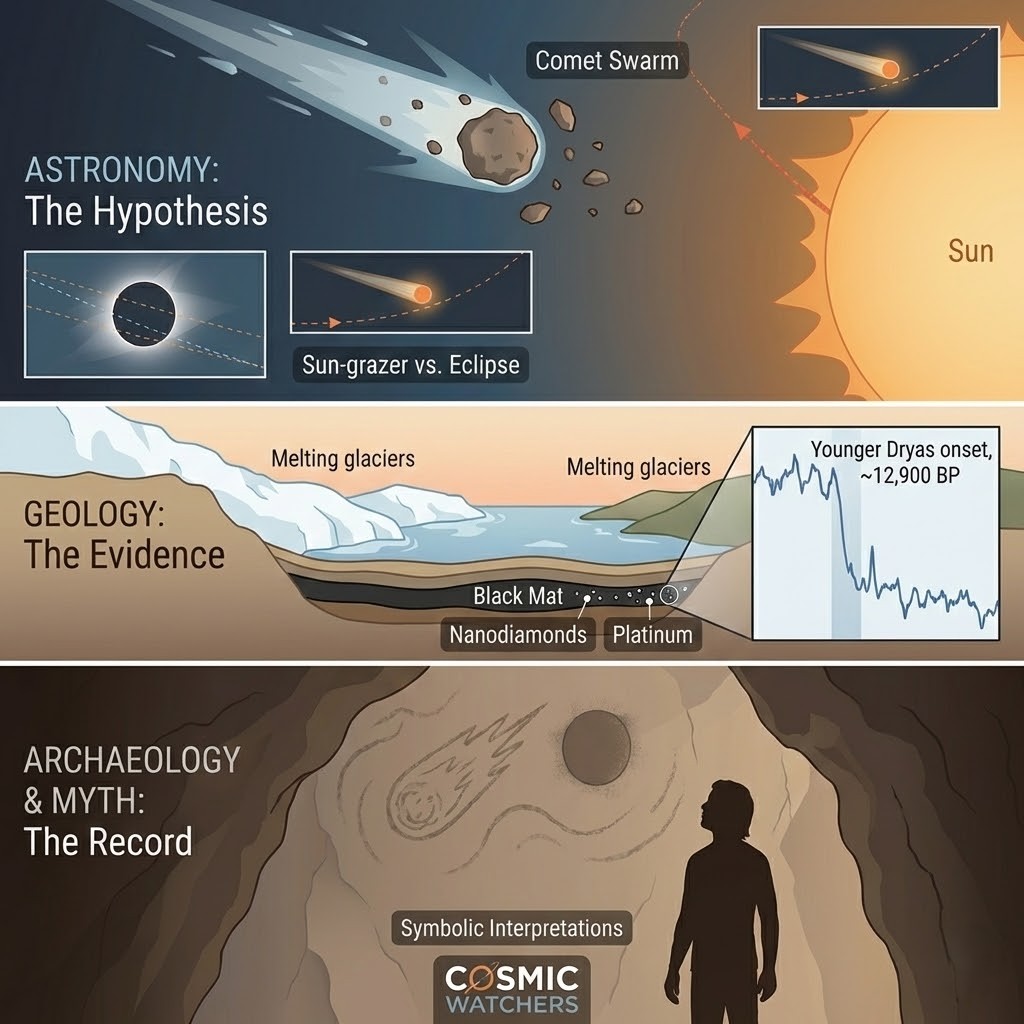
Around 12,900 years ago, as the last Ice Age was drawing to a close, Earth experienced a sudden and violent climate reversal. Temperatures in the Northern Hemisphere dropped rapidly, ecosystems were disrupted, large Ice Age animals vanished, and human cultures were forced to adapt or disappear. This period is known to science as the Younger Dryas.
Alongside the geological evidence, a more provocative idea has emerged over the last few decades: that a comet or fragments of a comet may have played a role in triggering this abrupt change. Even more intriguing are ancient depictions—some claimed to be from regions such as the Amazon—that appear to show a comet moving toward the Sun. According to one interpretation, such a sight would only be possible during a solar eclipse.
So how much of this holds up under careful examination?
The Younger Dryas: what we know for certain
The Younger Dryas began suddenly around 12,900 years ago and lasted for roughly 1,200 years. This much is well established.
What mainstream science agrees on:
- A sharp cooling event occurred after a period of warming
- Ice sheets temporarily stabilized or re-advanced
- Sea levels eventually rose dramatically as melting resumed
- Megafauna such as mammoths and mastodons declined rapidly
- Human cultures underwent major transitions
The speed of these changes is what makes the Younger Dryas unusual. Climate typically shifts over long periods, yet this reversal appears to have unfolded within decades.
The Younger Dryas impact hypothesis
To explain the suddenness, some researchers have proposed the Younger Dryas impact hypothesis. According to this idea, Earth encountered a large comet or a swarm of comet fragments.
Rather than a single crater-forming impact, the event may have involved:
- Airbursts over ice sheets
- Fragmentation in the atmosphere
- Regional explosions similar in nature to the Tunguska event
Supporters of the hypothesis point to evidence found at sites across multiple continents, including:
- Nanodiamonds
- Metallic spherules
- Platinum anomalies
- Widespread charcoal layers suggesting intense fires
Critics argue that these signatures can have non-cosmic explanations and that no definitive crater has been identified. As of now, the hypothesis remains debated, not accepted or dismissed outright.
Did a comet cause sea level rise?
One common misunderstanding is that a single event caused oceans to rise overnight. In reality:
- Sea level rise occurred over centuries to millennia
- Ice sheets were already unstable
- Meltwater pulses accelerated flooding of coastlines
If a cosmic event played a role, it would likely have acted as a trigger, not the sole cause.
The comet-and-Sun depictions
Some ancient images are said to show a comet ascending toward the Sun. This has led to the claim that such a sight could only be observed during a solar eclipse, when the Sun’s glare is reduced.
At first glance, the idea sounds convincing. But astronomy tells a more nuanced story.
Can a comet be seen near the Sun without an eclipse?
Yes—under the right conditions.
Certain comets, especially sun-grazing comets, approach extremely close to the Sun. These can sometimes be observed:
- At dawn or dusk
- When the Sun is low on the horizon
- Through atmospheric haze that reduces glare
Perspective effects and plasma tails can also make a comet appear to point toward the Sun rather than away from it.
A total solar eclipse does allow brief visibility of objects near the Sun, but:
- Totality lasts only minutes
- Visibility is limited
- The timing would have to be extraordinarily precise
An eclipse is therefore not required to explain such imagery.
What about eclipse simulation software?
Modern astronomy software can calculate ancient eclipses by modeling the motions of Earth and the Moon. In principle, it can show that solar eclipses did occur around 13,000 years ago.
However, there is an important limitation.
Earth’s rotation is not constant. Small changes accumulate over thousands of years, creating uncertainty in eclipse calculations. At such deep timescales:
- Eclipse paths can shift by hundreds or even thousands of kilometers
- Exact timing becomes uncertain
- Local visibility cannot be confirmed with confidence
In other words, software can show that an eclipse was possible somewhere on Earth, but not that it was definitively visible from a specific site or connected to a specific event.
It is also worth remembering that solar eclipses are not rare. Over several centuries, hundreds would have occurred worldwide.
Symbolism versus literal recording
Another key factor is how ancient people recorded knowledge.
Traditional cultures did not aim to produce photographic records of the sky. Instead, they emphasized:
- Meaning over mechanics
- Cycles over dates
- Cosmic order over exact geometry
Across many cultures, comets were associated with:
- Upheaval
- The end of an age
- Destruction followed by renewal
An image of a comet entering or approaching the Sun may therefore represent cosmic disruption, not a literal snapshot of a single afternoon sky.
A careful conclusion
- A dramatic global event occurred around 12,900 years ago
- The climate shift was abrupt and severe
- A cosmic encounter remains a possibility, though unproven
- Eclipse calculations that far back carry large uncertainties
- Ancient imagery is as much symbolic as observational
The idea of a comet, a darkened Sun, and the end of the Ice Age sits at the intersection of astronomy, geology, archaeology, and myth. It is a reminder that Earth’s past may include episodes of sudden change—and that ancient people, watching the sky with care and reverence, may have encoded those memories in ways we are only beginning to understand.
At Cosmic Watchers, we explore these moments not to force conclusions, but to ask better questions about our planet’s deep history and its place in the wider cosmos.
 Cosmic Watchers
Leave a comment