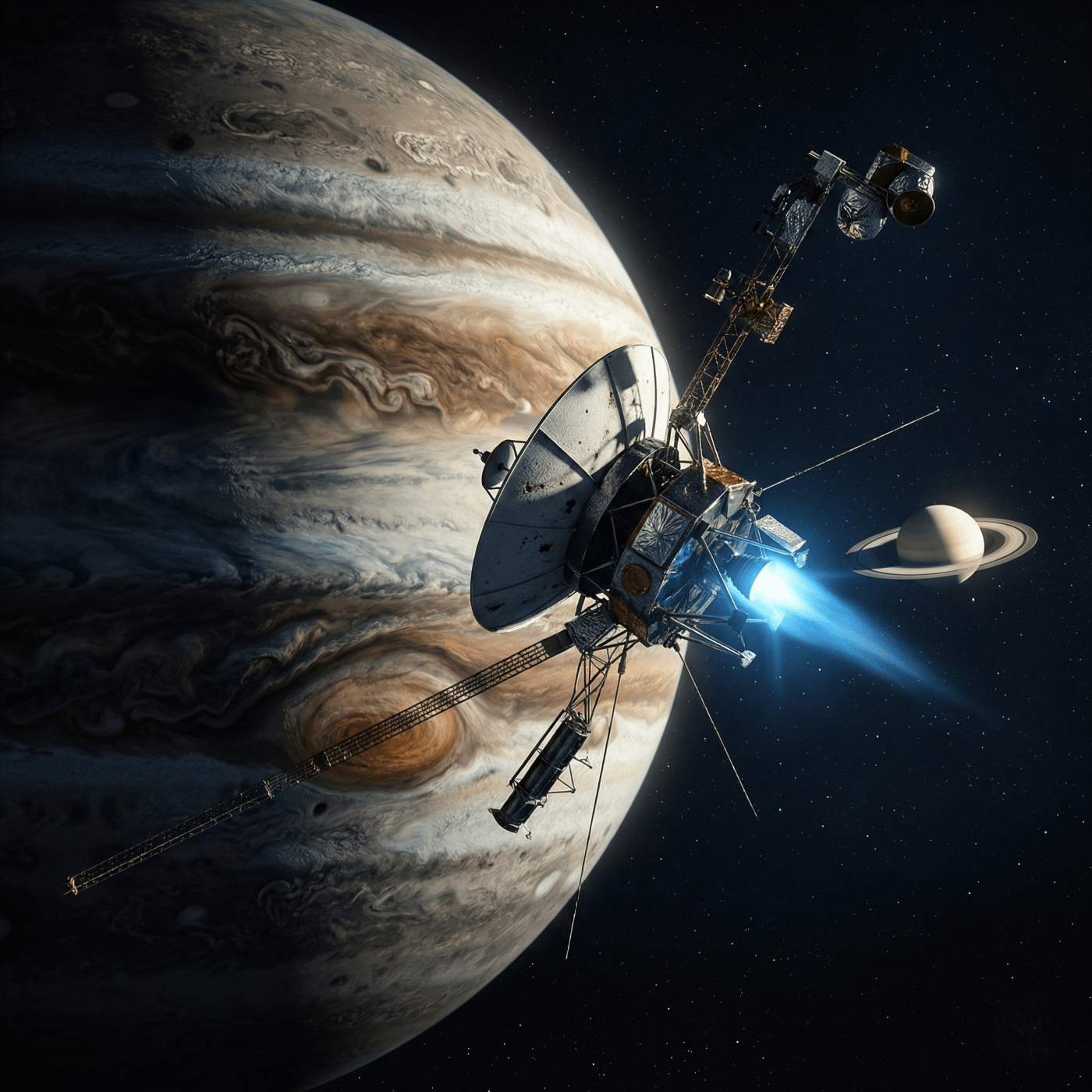
Let’s drop the poetry. Once you pass the asteroid belt, the solar system stops being about rocky little worlds like Earth or Mars. Out there, it becomes the realm of giants.
Jupiter and Saturn are the gas giants—the heavyweights of our planetary neighborhood. They dominate everything around them and play by rules very different from the inner planets. And if we want to reach Saturn—or even understand how the outer solar system works—we have to deal with Jupiter first.
Here’s a clear-eyed look at the two biggest beasts in the sky, and why one is the key to reaching the other.
The Tale of the Tape
In photographs, Jupiter and Saturn look calm and distant. In reality, they are violent worlds of crushing pressure and extreme gravity—places that would destroy an unprotected spacecraft in short order.
Jupiter: The Brute
Jupiter is the undisputed heavyweight champion of the solar system.
- Mass: More than twice the mass of all the other planets combined, and about three times heavier than Saturn.
- Size: You could fit roughly 1,300 Earths inside it.
- Gravity: Its immense pull acts like a cosmic vacuum cleaner, capturing or deflecting asteroids and comets that might otherwise head toward the inner planets.
Jupiter isn’t just big—it runs the show.
Saturn: The Lightweight Giant
Saturn is still enormous, but compared to Jupiter, it’s strangely delicate.
- Size: Large enough to hold about 764 Earths.
- Density: Saturn is the least dense planet in the solar system—less dense than water.
The reality: If you could build a bathtub big enough, Saturn would float. Jupiter would sink straight to the bottom.
- The Rings: Saturn’s iconic ring system stretches hundreds of thousands of miles from the planet. The rings themselves are thin, made of ice and debris, but they create the illusion of a world even larger than it already is.
The Void Between
Most diagrams of the solar system are misleading. They squeeze the planets together so they fit neatly on a page. Space doesn’t work that way.
Jupiter and Saturn are not fixed points; they orbit the Sun at different speeds and distances. Even when they line up on the same side of the solar system, the gap between them is enormous.
- Closest approach: About 400 million miles apart.
- That’s roughly four times the distance between Earth and the Sun.
Getting to Jupiter takes about five years with current technology. When you arrive, you’re still only partway to Saturn. Beyond Jupiter lies a long, cold, empty stretch of space that makes mission planning extremely difficult.
The Jupiter Slingshot
Does Jupiter’s gravity affect our ability to reach Saturn? Absolutely. In practice, we can’t do it without Jupiter’s help.
Rocket fuel is heavy and expensive. We simply can’t carry enough of it to fly directly to Saturn at high speed. Instead, we use a time-tested trick called a gravity assist.
The process works like this:
- A spacecraft is aimed toward Jupiter, but not straight at it.
- As the craft falls into Jupiter’s gravitational well, the planet’s massive gravity bends its trajectory.
- The spacecraft swings around the far side of Jupiter and is flung back out at a much higher speed.
The result: The spacecraft steals a tiny amount of Jupiter’s orbital momentum and uses it to reach the outer solar system.
The cost: Jupiter slows down by an almost immeasurable amount—on the order of inches over billions of years. The planet never notices. We get a massive boost.
Without Jupiter acting as a gravitational slingshot, missions to Saturn would take far longer—or might not be practical at all.
The Next Mission: Dragonfly
So, is a mission to Saturn happening again? Yes—and it’s one of the most ambitious ones yet.
NASA is building Dragonfly, and it’s unlike anything we’ve sent to the outer solar system before.
- The Mission: A nuclear-powered, dual-quadcopter drone.
- Destination: Titan, Saturn’s largest moon.
- Launch: Planned for July 2028.
- Arrival: Expected in 2034.
Titan is a world with a thick atmosphere, rivers, and lakes of liquid methane and ethane. Dragonfly won’t just orbit or land—it will fly, hopping from site to site and sampling one of the most Earth-like (and alien) environments we’ve ever found.
The Bottom Line
Jupiter is the muscle. Saturn is the prize.
The distances are vast, the radiation is brutal, and the cold is unforgiving. But we’ve made this journey before with missions like Voyager and Cassini, using Jupiter’s gravity as our gateway to the outer solar system.
Now we’re preparing to do it again—this time not just to look, but to explore an entirely new world beneath Saturn’s distant rings.
 Cosmic Watchers
Leave a comment