The Earth's magnetic field serves as a crucial shield, protecting our planet from the relentless bombardment of cosmic rays and charged particles emitted by the Sun. This invisible force, generated by the movement of molten iron in the Earth's outer core, extends far into space, forming a protective bubble known as the magnetosphere. However, this... Continue Reading →
Why Are Stars So Hot? The Process Explained
Why Are Stars Hot? Stars are fiery giants because of gravity and nuclear fusion. If a mass of gas—at least 80 times Jupiter’s size—collapses under its own gravity, the intense pressure ignites fusion, turning hydrogen into helium and releasing enormous energy. This process generates immense heat and light, making stars shine for billions of years.... Continue Reading →
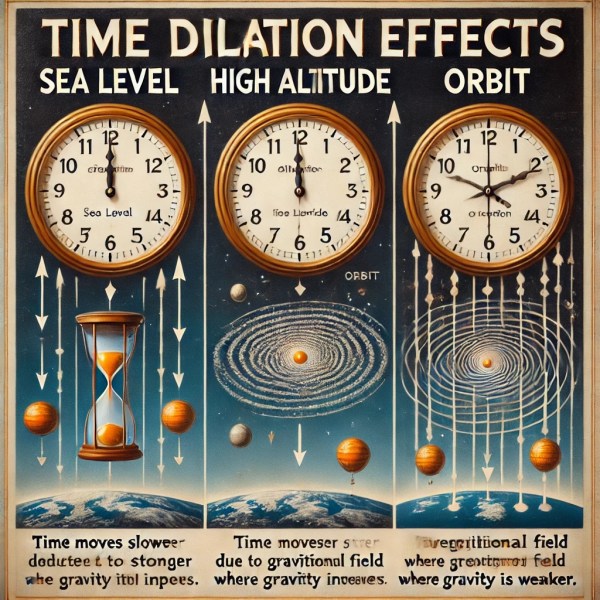
Gravity and Time: How Your Altitude Affects the Flow of Time
Time is not as constant as we might think. While we experience it as a steady progression of seconds and minutes, physics tells us otherwise. The force of gravity actually changes the scale of time, making it flow differently depending on where you are. This means that even in a tall building, time moves at... Continue Reading →
Exploring the Pleiades Star Cluster
The Pleiades, a striking star cluster in Taurus, captivates cultures and astronomers alike. Comprising young stars and rich mythology, it’s crucial for stellar studies and cosmic exploration.
Life Beyond Mars: Could It Exist on Icy Moons?
Exploring beyond Mars, we find giant planets and their moons, particularly Europa, a potentially life-hosting moon of Jupiter. Covered in ice, it may harbor a hidden ocean teeming with life, similar to Earth's icy regions. Upcoming missions aim to uncover signs of life, marking Europa as a key focus in extraterrestrial research.
The Asteroid We Almost Missed: A Close Encounter on January 25, 2024
On January 25, 2024, an asteroid passed closer to Earth than expected, reminding us of the ever-present threat of near-Earth objects (NEOs). While not an immediate danger, its unexpected flyby raises concerns about our ability to track asteroids in time. How Close Did It Get? The asteroid, designated 2024 YR4, passed within approximately 830,000 km... Continue Reading →
HD 101581: A Star with Two Earth-Sized Exoplanets
HD 101581 is a K-type main-sequence star located approximately 41.7 light-years away in the constellation Centaurus. With an apparent magnitude of 7.77, it is not visible to the naked eye but can be observed with small telescopes. This relatively close star has attracted scientific interest due to the discovery of two Earth-sized exoplanets, HD 101581... Continue Reading →
James Webb Won’t Discover Exoplanets? Think Again!
James Webb Won't Discover Exoplanets? Think Again! Many believe the James Webb Space Telescope (JWST) won’t be discovering new planets—and they’re mostly right! But JWST’s true strength lies in something even more crucial: unlocking the secrets of known exoplanets. Unlike smaller telescopes that find new worlds, JWST specializes in analyzing their atmospheres, detecting elements like carbon dioxide and methane, and even identifying potential ocean-covered planets. Its work is revolutionizing our understanding of alien worlds, bringing us closer to finding habitable planets beyond Earth. Want to know how? Read on!
The Stars Are Not Visible in Space! Or Are They?
Are stars not visible in space? When we see photos taken from the International Space Station (ISS) or during the Apollo moon landings, one thing seems to be missing—stars! These images show astronauts, spacecraft, and planetary surfaces, but the vast cosmos appears completely black. This has led some to question: Are stars not visible in... Continue Reading →
Are We Missing Alien Signals?
For years, we've searched the skies, listening for radio signals that might reveal alien life. But what if we're listening the wrong way? As Earth shifted from radio waves to fiber-optic light signals, could advanced civilizations have done the same? Every day, mysterious bursts of light and energy reach us from the cosmos—perhaps they hold messages we've yet to understand. If we expand our search beyond radio waves, we might finally uncover the voices of the universe