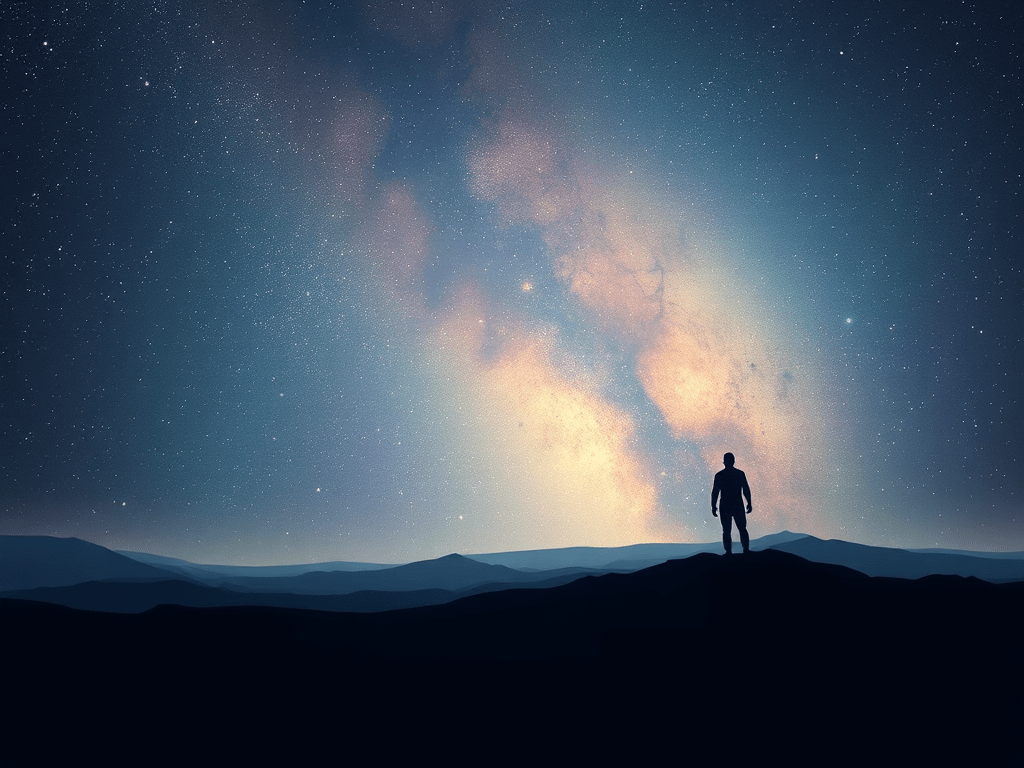
Since the dawn of radio, we have been listening. Hoping. Searching.
Yet the universe remains silent.
Despite over a century of technological advancement and decades of scanning the stars for signs of intelligent life, the cosmos offers no reply. This puzzling absence—known as the Great Silence—stands in contrast to the logical expectation that life should be abundant among the stars. After all, there are hundreds of billions of galaxies, each with hundreds of billions of stars, and many of those stars host planets not so different from our own.
So… why the silence?
And what if the silence isn’t accidental—but deliberate?
A Cosmic Cold Shoulder?
This possibility—the idea that alien civilizations are actively avoiding us—is unsettling. It falls under a family of solutions to the Fermi Paradox that some call The Zoo Hypothesis or The Great Filter by Design. These theories propose that we’re either being observed from a distance or being ignored altogether… on purpose.
Imagine humanity as a young species, still learning to walk, while more advanced beings watch quietly from the shadows. Like researchers observing wildlife from behind a one-way mirror, they may be choosing not to interfere.
But why?
Three Reasons We Might Be Ignored
1. We’re Not Ready.
Just as we don’t teach algebra to a child still learning to count, a higher civilization may consider us too primitive. Our history is steeped in warfare, environmental destruction, and short-sighted decisions. Contact may only occur once we pass some unspoken test—one based not on technology, but on wisdom.
2. We’re in a Preserve.
Earth might be part of a larger galactic ethic—a sort of protected reserve, where native civilizations are allowed to evolve without interference. To break that silence might be considered unethical, like feeding wild animals in a national park.
3. It’s Dangerous to Speak.
Perhaps the cosmos is quiet because everyone is hiding. The first civilizations to emerge might have learned the hard way that broadcasting your presence can bring catastrophic consequences. If a predatory species exists—or once did—then silence becomes a survival tactic. In this view, we’re the loud ones, and that’s not a good thing.
The Ancient Library Analogy
Think of the universe as a vast, ancient library. Some books are billions of years old. Some civilizations may have long since burned out, leaving behind only whispers in the dust. Others may still be reading—but in languages we cannot decipher, or through means we’ve yet to imagine.
Just as medieval Europeans had no concept of radio waves, we may be blind to the forms of communication more advanced beings would use. Their silence might not be silence at all—only our deafness.
Signs We May Have Missed?
In 2017, the strange interstellar object known as ʻOumuamua passed through our solar system. While many scientists believe it to be natural, some respected researchers have suggested it could have been a probe—or at least a relic of some otherworldly origin. If true, it may have been a whisper from the void, misread as static.
Likewise, the so-called “Wow!” signal from 1977 remains unexplained to this day—a 72-second burst of energy that looked distinctly artificial but was never repeated. A one-time ping from a cautious intelligence?
Would We Do the Same?
Perhaps the most humbling question of all: If we discovered a planet like Earth, teeming with early life and warlike tendencies, would we make contact?
Or would we wait and watch—perhaps for thousands of years?
We value tradition, caution, and observation. It’s not hard to imagine that others, older and wiser, might too.
In the End…
The silence of the stars might be nothing more than distance and time. Or it might be something more intentional—more intelligent.
Maybe we are not alone.
Maybe we are simply not yet invited to the conversation.
Until then, we listen.
And the watchers… keep watching.
Here at Cosmic Watchers, we’re listening with you.


About those who observe — and those who listen
The silence of the universe is so easy to mistake for emptiness.
But emptiness is rarely empty.
Sometimes it is simply a space where we have not yet learned to hear.
We often forget one simple thing:
it is not only we who are trying to understand the universe — perhaps the universe is trying to understand us.
What if we are not the seekers, but the studied?
We look into space like a child who peeks into a dark room and asks:
“Is anyone there?”
But the child did not think that someone might be looking back at him — and remaining silent not out of indifference, but out of caution.
Higher civilizations, if they exist, may understand feelings the same way we understand the fragility of glass:
one careless movement — and everything is destroyed.
Perhaps they remain silent because they know too well the price of intervention.
Earth as a mirror
There is another thought that makes it strangely quiet inside:
what if our existence is an experiment not on us, but on the universe itself?
What if consciousness is a rare instrument through which the cosmos looks at itself?
And we are just one of its countless eyes.
In this case, silence is not an absence of communication.
It is like the respectful waiting of a younger interlocutor who is given the opportunity to formulate their first thoughts.
About the fear of being noticed
We are afraid of what other civilizations might do to us.
But we rarely ask ourselves another question:
what will we do if this silence is suddenly broken?
We are still arguing about national borders — are we ready for galactic borders?
We cannot agree on the value of human life — are we ready for extraterrestrial value?
We are barely learning to understand ourselves — are we ready to understand those who are neither outwardly nor inwardly like us?
Perhaps the silence is not a protection for them from us, but for us from ourselves.
About those who came before us
If there are civilizations in space that are millions or billions of years older than us, their experience is indescribable.
They have seen young stars that have already died.
They have seen the rise and fall of worlds.
They have seen how intelligence can become either a light or a weapon.
We consider ourselves young, but on a galactic scale, we are not even infants.
We are still just a spark.
And perhaps somewhere there are those for whom this spark is a long-studied phenomenon.
We are also observers.
And here’s what’s important:
if they are watching us, that doesn’t make us passive.
Because there is one detail that people underestimate:
Observation is also a form of participation.
Every glance we cast at the sky is a message.
Every question we ask is a signal.
Every attempt we make to understand is a step toward a dialogue that has not yet begun but is already possible.
We are not alone in this silence.
We are part of it.
We are the ones who are learning to hear.
And one last thing…
Perhaps one day, when we become quieter inside than around us, when we stop shouting in fear and learn to speak with meaning, the stars will respond.
LikeLiked by 1 person